How Content Ratings Protect Teens Online
Discover how content ratings create safer spaces online. Learn why movie-style ratings help families talk about digital safety and give teens control.

Table of Contents
Content Ratings Help Families Stay Safe Online
Content ratings are changing how families approach digital safety. Think about how you choose movies for your family. You check the rating. A PG movie tells you there's mild content. An R movie signals something stronger. This system works because it's clear, familiar, and puts control in your hands.
Social media doesn't always work this way. Teens scroll through feeds filled with videos they didn't ask to see. Posts from accounts they don't follow appear without warning. A violent clip, a suggestive image, or upsetting news can catch them off guard. That's where content ratings come in.
Content ratings use the same language families understand from movies and games. They filter what teens see before it reaches their screens. They start conversations. They give teens real agency in their own digital lives. Here's how content ratings protect teens online and why they matter for your family.
How Content Ratings Filter Age-Inappropriate Content Before Teens See It
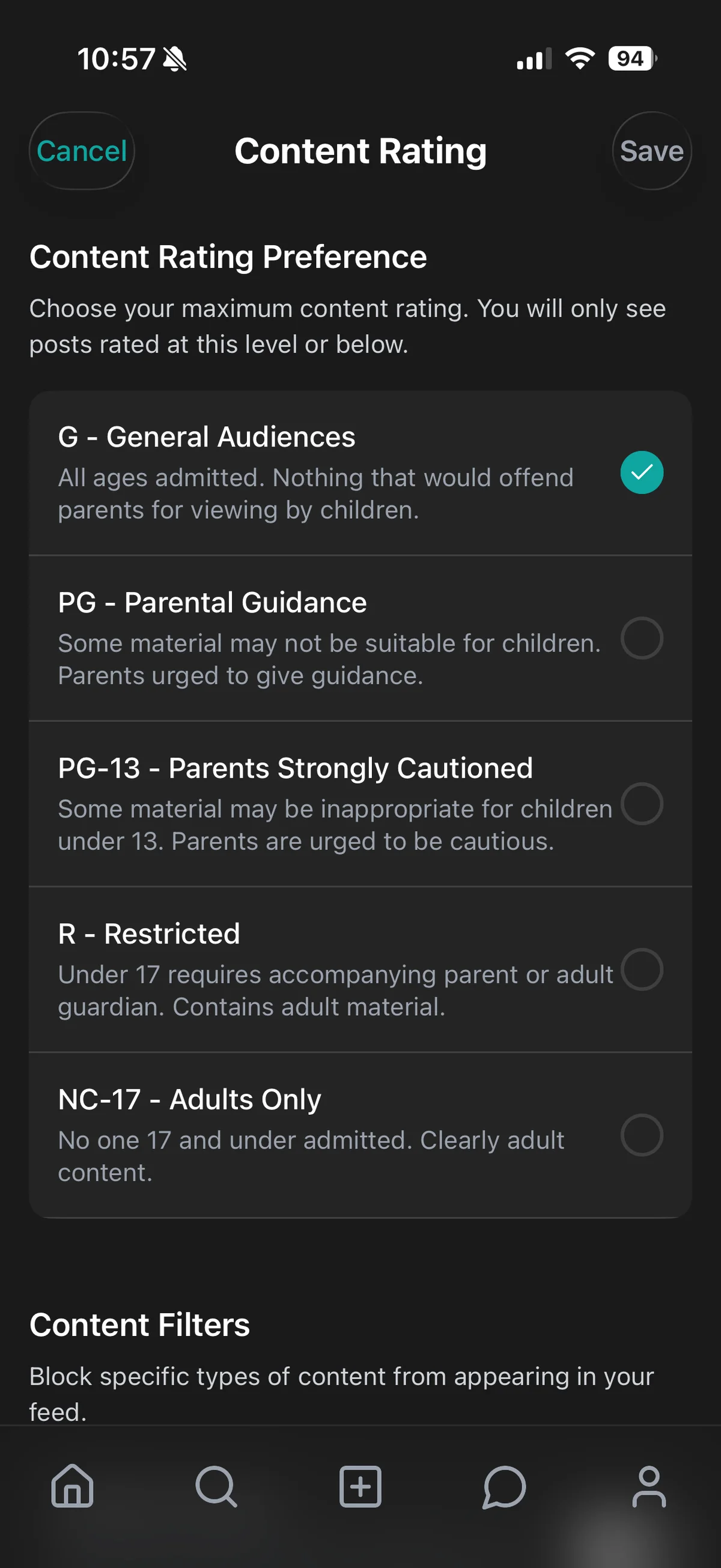
The most obvious benefit of content ratings is what they block before it ever reaches a young person's feed. When a post gets flagged as PG-13 or R, it stays off the screen of someone with a G or PG filter.
This doesn't require parental monitoring every second. It doesn't demand constant conversation about what went wrong. Instead, the system acts as a first line of defense. Violent content, sexual imagery, and other mature material simply don't appear.
This matters because teens often encounter inappropriate content by accident. A friend shares something. An algorithm suggests it. A trending video shows up in recommendations. With content ratings, these moments happen less often. The filter works quietly in the background.
Parents benefit too. You're not the bad guy blocking everything. The system is. Teens understand that some content has a rating. Just like they can't buy an R-rated movie ticket alone, they can't bypass age filters. It feels fair because it mirrors rules they already know.
Research shows that early exposure to violent or sexual content affects how teens develop attitudes about relationships and safety. Content ratings reduce that exposure. That protection happens automatically, every single day.
Content Ratings Give Parents a Conversation Starting Point
The best families talk about what they see online. But those conversations are hard to start. "What are you looking at?" feels invasive. "We need to talk about social media safety" can sound like a lecture. Both approaches create distance right when you want connection.
Content ratings change this dynamic. When a post has a rating, it becomes concrete. You can say, "I noticed you're seeing PG-13 content now. What made you want to adjust your filter?" That question opens dialogue instead of shutting it down.
Ratings also give you language that's already familiar. You've probably discussed movie ratings with your teen. You've explained why certain games aren't appropriate yet. These conversations happened naturally. Content ratings let you extend those conversations to the space where teens actually spend time.
Parents also appreciate that ratings don't require you to scroll through everything yourself. You don't need to become a social media expert overnight. You just need to know what filter level your teen is seeing. That knowledge becomes the foundation for trust-based conversations.
The most meaningful safety happens when families talk openly. Content ratings aren't a substitute for those talks. They're the spark that makes them easier to have.
Content Ratings Put Teens in Control of Age-Appropriate Choices
Autonomy matters during the teenage years. Teens are developing their own judgment. They want to make decisions. They need to learn what feels right to them.
Content ratings for teens make this possible in a structured way. A 14-year-old with a PG filter is making an active choice. They're not getting everything. They're not locked in the G section forever. They're exercising judgment within boundaries that make sense for their maturity level.
This is different from parental controls that feel restrictive. When parents set a filter, it's the system making rules. When teens choose to bump up to PG at 13 or PG-13 at 15, it's the teen making a decision. That distinction matters psychologically.
Teens also appreciate transparency. Content ratings tell them exactly why something isn't available. It's not mysterious or frustrating. The system is clear: this post is rated R. Your filter is PG-13. You can adjust if you want to, but your parents will know. That honesty builds trust.
The best teen safety doesn't come from perfect restriction. It comes from teens learning to make good choices while still protected. Content ratings create that balance. Teens get agency. Parents retain visibility. The system respects both perspectives.
Reducing Accidental Exposure to Violent or Sexual Content Matters
Accidental exposure is one of the hardest challenges teens face online. A friend shares a link without warning about the content. An algorithm recommendation includes something unexpected. A meme in a group chat turns out to contain disturbing imagery. These moments happen fast.
When teens are exposed to violent or sexual content unexpectedly, it affects them. They may experience anxiety or distress. They may normalize content that isn't healthy. They may feel embarrassed or unsure how to process what they saw. Some teens don't even tell adults because they're worried they'll lose device privileges.
Content ratings reduce these moments dramatically. With a functioning rating system, violent and sexual content simply doesn't appear on young teen feeds. When a teen adjusts their filter to access more mature content, they do so deliberately. It's not an accident. It's not a surprise.
This protection extends to text and images too. A post with graphic violence gets rated accordingly. A video with sexual content gets flagged. The system catches things before a teen stumbles on them unexpectedly.
Parents often feel guilty about the internet their kids navigate. Content ratings shift responsibility where it belongs: to the platforms themselves. These companies can and should filter content appropriately. Content ratings make that filtering visible and consistent.
Content Ratings Create Safer Spaces for Younger Users to Explore
Young teens want independence. They're eager to join social media. But many platforms feel designed for older users. The content is sometimes too mature. The pace is overwhelming. The social dynamics can be harsh.
Content ratings change this equation. With proper filtering, a 12-year-old can explore social media in an age-appropriate version. They can follow their interests. They can connect with peers. They can build confidence without drowning in mature content.
This safety is crucial because early experiences matter. A young teen who feels safe exploring social media develops healthy habits. They learn navigation skills. They understand how to express themselves. They build resilience in lower-stakes environments. These skills transfer as they age and encounter more complex online spaces.
Content ratings for teens also reduce the pressure to seem older than they are. Some teens adjust their appearance or behavior online to fit in with older users. When the feed itself feels age-appropriate, that pressure lessens. They can just be themselves.
Platforms benefit too. Younger users who feel safe stay longer. They're more likely to develop positive connections. They're less likely to experience harassment or cyberbullying in age-segregated spaces. The whole community is healthier when each age group has appropriate spaces.
For parents of younger teens, content ratings feel like permission to say yes. Instead of banning social media entirely, you can say, "Yes, you can join. And we'll set your filter to keep you safe while you're learning." That balance is powerful for family relationships.
Content Ratings Mirror a System Teens Already Understand
Here's a secret: teenagers already understand ratings. They've been seeing G, PG, PG-13, R, and NC-17 labels since childhood. They understand why their 8-year-old sibling can't watch an R-rated movie. They get that some content is just not for their age.
Video games use ratings too. ESRB ratings are everywhere. Teens navigating a gaming platform understand that M-rated games are different from T-rated games. They know these categories mean something.
When content ratings appear on social media using the same system, it clicks immediately. There's no learning curve. No confusing new vocabulary. No sense that adults are trying to trick them with something they don't understand.
This familiarity is remarkably powerful. It removes friction from safety conversations. When you say, "This post is rated R," your teen knows exactly what you mean. They're not confused or defensive. They just understand.
The system also feels inherently fair because it's used everywhere. Teens can't watch an R movie without parent permission, they can't buy M-rated games without verification, and they can't see R-rated content on social media with a lower filter. Consistency across systems makes the rules feel legitimate instead of arbitrary.
Using existing rating systems also solves a practical problem. Content raters can apply consistent standards because the criteria already exist. A post with graphic violence is R in movies, games, and on social media. This consistency removes the accusation that ratings are biased or unclear.
Teens respect systems they understand. Content ratings use language and logic from their entire media diet. That respect translates into cooperation and genuine buy-in to safety practices.
Building Safer Online Spaces Together
Content ratings aren't a perfect solution. No single tool protects teens entirely. But they're a powerful piece of a larger safety framework. They reduce exposure to inappropriate content. They create opportunities for conversations. They give teens agency. They build on systems families already understand.
The most important thing about content ratings is what they make possible. With ratings in place, parents can relax slightly. Teens can explore more freely. Conversations about online safety happen more naturally. Everyone gets a little more breathing room.
At CleoSocial, we built content ratings because we believe families deserve better tools. We believe teens deserve spaces where they can be themselves safely. We believe parents deserve to feel confident about their teen's online time.
If you're a parent wondering whether to try content ratings, start with our family setup guide, then start a conversation with your teen. Explain how they work. Ask what filter level feels right to them. Listen to their reasoning. You might be surprised by how thoughtful they are about their own safety when given the choice.
If you're a teen reading this, content ratings are a tool you can control too. You don't have to keep a filter forever. You can adjust as you grow. You can have honest conversations with your family about what you're ready to see. You're not powerless in your own online experience.
Online safety is a shared responsibility. Content ratings help everyone play their part. They make the internet feel a little less overwhelming and a lot more navigable. And that matters for the teens in your life.
Learn more about how content ratings work in the CleoSocial app. Check out our privacy and safety practices or explore more teen safety resources. We're also committed to transparent communication. See how we think about protecting young users in our about section.
For additional perspective, the American Academy of Pediatrics offers research-backed guidance on media use for teens. Common Sense Media provides detailed content reviews and ratings. The CDC publishes resources on adolescent health and digital safety.
Ready for Social Media That Respects You?
CleoSocial puts you in control. Content ratings, time limits, and real connections. Free to use, always.