What Every Parent Needs to Know About Kids and Social Media
Understand how algorithms, screen time, and content ratings affect your kids. Learn practical guidance for safer social media use at home.

Table of Contents
If you're raising kids in 2026, you've probably noticed social media is everywhere. Your child isn't just scrolling through photos anymore. They're navigating complex algorithms, managing digital friendships, and encountering content you might never see. Understanding what's happening behind the screen matters more than ever.
Social media isn't inherently bad, but it is powerful. It shapes what your child sees, thinks about, and feels about themselves. The good news? You don't need to be a tech expert to help your child use social media safely. You just need to know what to watch for and how to talk about it.
This guide covers what every parent should understand about kids and social media. These aren't theoretical concepts. They're practical realities that affect your child's daily life online.
Your Child's Feed Isn't Random
When your kid opens their favorite social app, that feed looks personal. Custom. Like the platform created it just for them. That's partly true. But it's also engineered.
Algorithms decide what your child sees. These systems learn from every action: what they like, share, comment on, and even what they pause to read. The algorithm notices which videos they watch until the end and which ones they skip. Over time, it becomes remarkably accurate at predicting what will keep your child engaged.
This matters because engagement is what platforms optimize for. Longer time on app equals more ad impressions. More scrolling equals more data collection. The algorithm isn't primarily designed around your child's wellbeing. It's designed around business goals.
Understanding this changes how you talk to your kids about their feeds. They're not seeing what's most important or true. They're seeing what the algorithm predicts they'll engage with most. Sometimes that's funny cat videos. Sometimes it's content designed to trigger strong emotions like anger or anxiety.
Ask your child what they've been seeing lately. You might be surprised. The feeds different people see can be wildly different, even if they're following the same accounts.
Why Screen Time Hits Kids Differently
Your child's brain is still developing. That's not just a figure of speech. Until around age 25, the prefrontal cortex—the part that handles impulse control, judgment, and delayed gratification—is still forming.
Social media is designed to trigger dopamine responses. That little notification, that thumbs-up on their post, that new follower count. These trigger the same reward circuits that make other activities pleasurable. But social media delivers these rewards on an unpredictable schedule, which makes it especially engaging to developing brains.
Research from organizations like the American Academy of Pediatrics shows that excessive screen time connects to sleep problems, attention difficulties, and mood changes in kids. More screen time doesn't automatically mean more harm, but the way kids use devices matters. Passive scrolling before bed affects sleep differently than watching a show with a set ending time.
This isn't about demonizing screens. It's about recognizing that time on social media replaces other activities. Hours scrolling is time not spent sleeping, moving, reading, or talking face-to-face. Kids need all of those things.
Setting reasonable limits isn't punishment. It's protection. Help your child build habits where social media fits into their life instead of consuming it.
Age-Appropriate Content Matters More Than You Think
Most social platforms officially require users to be 13 or older. But your 10-year-old's friend's older sibling's account might be accessible. Or your child might join with a fake birth year. Age restrictions exist for reasons.
Before age 13, children are developing their sense of self. They're more influenced by peers and less equipped to think critically about what they see. A 12-year-old watching content designed for 16-year-olds processes it differently than a 16-year-old does.
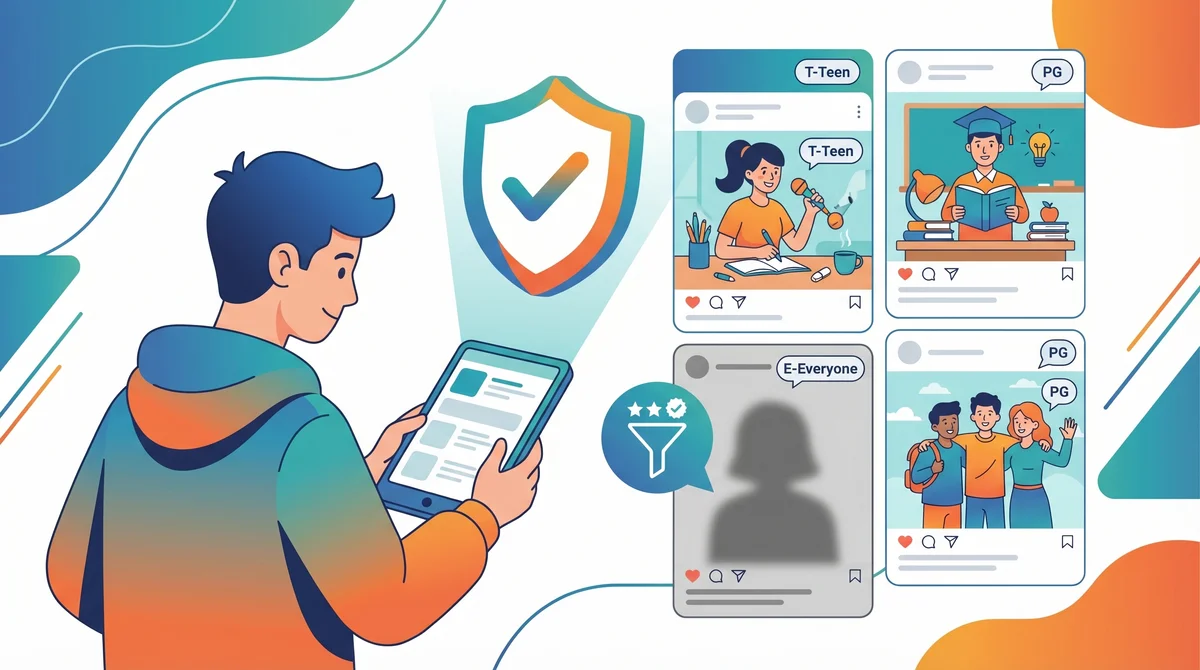
Content ratings exist to help with this. Movies have G, PG, PG-13, and R ratings for a reason. They help parents make informed choices. Learn more about how content ratings can help protect teens online. When social platforms include content ratings, those serve the same purpose. They signal what kind of content is in there so parents and kids can decide together what's appropriate.
Age-appropriate doesn't mean boring. It means content that matches what your child can emotionally and psychologically handle. It means reducing exposure to things like graphic violence, sexual content, or extreme dieting advice before your child's brain has the maturity to process it critically.
Talking about what's age-appropriate in your household is important. Different families have different comfort levels. What matters is that you're intentional about it instead of letting algorithms decide.
Content Ratings and Controls Give You Real Tools
This is where many parents feel lost. The default settings on most social platforms aren't optimized for safety. They're optimized for engagement. That means your child sees a lot.
Content rating systems change that equation. When a platform labels content—marking it as suitable for certain ages or content types—you get information. You can see what's in there before your child does. Or you can use those ratings to set filters that limit what appears in their feed.
The same goes for screen time controls. Many platforms now let users set limits on daily usage. This isn't about secretly monitoring your child. It's about giving them agency to manage their own time while having guardrails in place.
Using these tools isn't overly restrictive. It's informed parenting. You wouldn't send your child to a movie without knowing its rating. Checking content ratings on social platforms is the same principle. You're gathering information so you can guide your child's choices.
Start by exploring the safety and privacy settings on whatever platforms your child uses. Most of them have parental control options. If a platform doesn't, that's worth considering when deciding if it's right for your family.
Open Communication Works Better Than Surveillance
Here's something many parents get wrong: trying to secretly monitor every interaction. This builds distrust. When your child finds out you've been checking everything (and they will), they stop telling you what's happening.
Instead, create an environment where your child wants to tell you about social media. That means being genuinely curious, not judgmental. When they show you something, resist the urge to immediately critique their choices. Ask questions first.
"Why did you share that?" "What do your friends think about this?" "How did that comment make you feel?" These questions help your child think critically about their own choices. They also give you insight into what's happening in their digital life.
Share your own experiences too. You probably grew up before social media was everywhere, but you have experiences with peer pressure, fitting in, and comparing yourself to others. Those are the same challenges kids face now, just on a different platform.
Talk about what healthy social media use looks like. It's not zero social media. Most kids need to be online for school, to stay connected with friends, and because that's where their peers are. Healthy use means balance: time online balanced with time offline, socializing in person alongside digital interaction, consuming content while also creating things themselves.
When your child comes to you with a problem they encountered online, resist the urge to immediately take their phone away. Listen. Help them think through solutions. Being someone they trust when things go wrong matters more than preventing all problems.
Know the Warning Signs of Concerning Online Behavior
Most of your child's social media use is probably fine. They're keeping up with friends, sharing photos, scrolling through funny videos. But some warning signs suggest something more serious is happening.
Watch for sudden changes in mood or behavior tied to social media use. If your child seems anxious after going online, or if they check their phone obsessively, something might be off. Sudden withdrawal from friends or activities in real life, especially if they're spending more time online instead, is worth paying attention to.
Comments about wanting to change their appearance based on social media content, constant comparison to what they see online, or mentions of mean comments from peers are signs your child needs support. Sleep disruption directly tied to late-night social media use also matters.
The most concerning warning signs involve isolation, extreme mood changes, or evidence that other kids are treating your child poorly online. If you see these, it's worth talking to your child directly and, if needed, involving a counselor or school professional.
This isn't about panic. Most kids experience some of these things occasionally without it becoming a serious problem. But patterns matter. Trust your instincts. If something feels off, ask questions.
When to Get Help
You can't be present for every moment your child spends online. That's not realistic, and actually, that would be unhealthy. Part of growing up is learning to navigate the world, including the digital one, with less constant parental oversight.
But you can create a support system. Knowing how to talk to your child about problems, how to report concerning content, and when to involve other adults makes a difference.
If your child experiences cyberbullying, most platforms have reporting tools. Use them. Document what happened. If it's serious, involve your child's school. Many schools now have policies about online behavior that harms students.
If you're concerned about your child's mental health related to social media use, talk to their pediatrician or a counselor. They can help you figure out if it's normal growing-up stuff or something that needs intervention.
Organizations like the American Academy of Pediatrics and Common Sense Media have resources specifically designed to help parents. The CDC also offers guidance on digital wellness. These aren't judgmental. They're practical starting points.
Remember: you're not supposed to know everything about social media. You're supposed to stay curious, keep talking to your child, and know what resources exist when you need them. That's enough.
Moving Forward
Social media is part of your child's world. That's not changing. But being informed changes how you navigate it together. Understanding what algorithms do, knowing what tools are available to manage screen time and content ratings, and staying in conversation with your child creates a foundation for safer, healthier use.
You don't need to be perfect at this. You need to be present and willing to learn. Your child doesn't need a parent who understands every app and trend. They need a parent who cares about their wellbeing and is willing to talk about what they're seeing and experiencing online.
Start with one thing. Maybe it's exploring the privacy settings on the platforms your child uses. Maybe it's having a conversation about what healthy social media use looks like. Maybe it's learning about content ratings. Each step you take creates more safety and more connection.
Your child's digital life matters because your child matters. Staying informed isn't just good parenting. It's caring for the whole person your child is becoming—online and off.
Resources
For more information on supporting your child online, check out:
- American Academy of Pediatrics Media and Children Guide
- Common Sense Media Parenting Resources
- CDC Digital Wellness Information
Learn more about how CleoSocial's content ratings and safety features help families navigate social media together. Visit our blog for more parenting and digital wellness articles, or review our privacy policy to understand how we protect your family's data.
Ready for Social Media That Respects You?
CleoSocial puts you in control. Content ratings, time limits, and real connections. Free to use, always.