What Actually Happens When You Delete a Social Media Account
Deactivate and delete are not the same thing, and most platforms count on you not knowing the difference. A plain-language walkthrough of where your data actually goes.
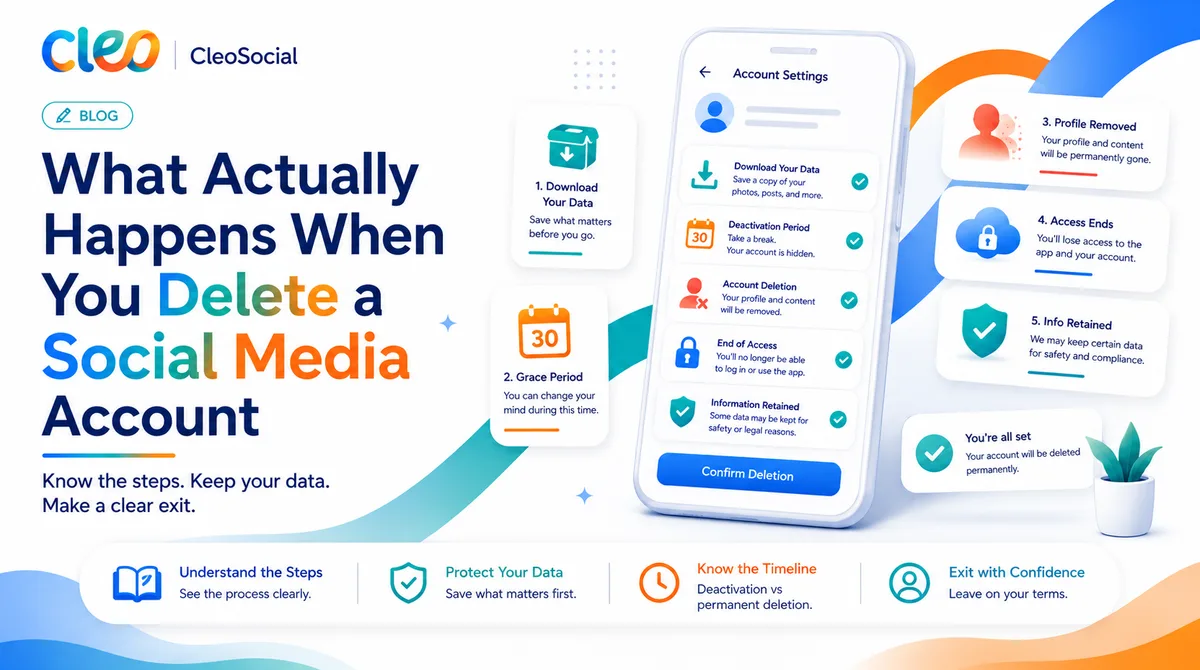
Table of Contents
What Actually Happens When You Delete a Social Media Account
"Delete my account" sounds like a final, complete action, and on most platforms it isn't one. There's usually a gap — sometimes small, sometimes measured in months — between clicking delete and your data actually being gone, and most people never read closely enough to know how wide that gap is on the app they just left. This is a plain walkthrough of what that process actually involves, because the terminology alone hides more than it should.
Deactivation Is Not Deletion
The first distinction almost every platform buries in its settings menu: deactivating an account and deleting one are different actions with very different outcomes. Deactivation typically hides your profile and posts from other users while keeping everything intact on the platform's servers, reversible the moment you log back in. It's designed to feel like a clean exit while functioning as a pause button. Deletion is the actual removal request — and even that comes with its own asterisks.
The Grace Period Most People Don't Know About
Most major platforms build in a grace period after a deletion request — often 30 days, sometimes longer — during which logging back in cancels the deletion entirely. The stated purpose is reasonable: preventing accidental or impulsive permanent deletions. The practical effect is that a huge share of deletion requests never complete, because a single login during the grace period — sometimes triggered by nothing more than an app auto-opening in the background — silently cancels it.
What "Deleted" Actually Means on the Backend
Even after a deletion request fully processes, "deleted" rarely means immediately and completely erased. Platforms typically retain data for a further period — sometimes 90 days, sometimes longer — for backup and legal-compliance purposes before it's purged from every system. Some categories of data get retained even longer: information already shared with advertising partners, aggregated analytics that no longer identify you individually but were built from your data, and anything a platform is legally required to keep for a set period regardless of your deletion request.
The FTC's guidance on data deletion is a useful starting point if you want to understand what companies are and aren't obligated to do with a deletion request — the short version is that requirements vary significantly by jurisdiction and by what specific data is involved, and "delete my account" doesn't carry one uniform legal meaning across the industry.
What Doesn't Come Back, Even With Full Deletion
Worth naming honestly: some things a deletion request can't undo, no matter how completely a platform processes it. Content other people saved, screenshotted, or reposted before you deleted your account isn't retrieved by your deletion — it exists on other people's devices and other platforms' servers, entirely outside your original account's control. Deletion removes your account's presence going forward; it doesn't reach back into what already left the platform through someone else's actions.
A Note on Data Portability, Not Just Deletion
Deletion isn't the only option worth knowing about, and it's often not the first step. Many platforms — under regulations like the EU's GDPR and, for California residents, the CCPA — are required to offer a data export option before or instead of deletion, letting you download a copy of what's been collected before it's gone for good. This matters most for photos, messages, and posts that exist only on the platform, since a deletion request that completes without an export first means that content is genuinely gone, not archived somewhere retrievable later.
The practical order worth following on any platform: request an export first, confirm it actually contains what you expect (some exports are surprisingly incomplete relative to what the platform actually holds), and only then proceed to deletion. Skipping the export step is the single most common regret people report after a platform deletion completes — not because the deletion itself was wrong, but because something worth keeping went with it.
How CleoSocial Handles a Deleted Social Media Account
We think the deactivation-versus-deletion distinction should be obvious rather than buried, so it's stated plainly rather than left to a settings submenu: deactivating pauses your presence and is reversible; deleting is a real removal request, with retention limited to what's operationally or legally necessary and nothing beyond that. There's no separate data trail sold to advertising partners to worry about untangling after the fact, because ads on CleoSocial are consent-gated rather than built on a profile assembled behind your back — which means there's simply less to retain in the first place, not just a faster process for retaining less of it.
Questions Worth Asking Before You Delete Anything
Whatever platform you're leaving, four questions are worth answering before you click delete: is this deactivation or deletion, and does the interface make the difference clear? Is there a grace period, and does logging in during it cancel the request? What's the stated retention window for data that isn't immediately purged? And is there a separate advertising or analytics profile that survives account deletion because it was never tied to the account in a way the deletion process reaches? A platform's privacy policy usually has these answers, even when the settings menu doesn't make them obvious.
The Bottom Line
"I deleted my account" is a phrase that means something different on almost every platform, and the gap between what it sounds like and what it actually does is exactly where a lot of people's data outlives their intent to remove it. Reading the actual policy, once, before you need to act on it urgently, is worth the ten minutes it takes.
Download CleoSocial free from the App Store, or read what CleoSocial actually collects to see the full picture before you'd ever need to delete anything.
Ready for Social Media That Respects You?
CleoSocial puts you in control. Content ratings, time limits, and real connections. Free to use, always.