How CleoSocial Makes Money: The Complete, Unhedged Breakdown
Where CleoSocial's revenue comes from, what it costs to run a rated feed, and why the business model is published instead of implied. The full picture.
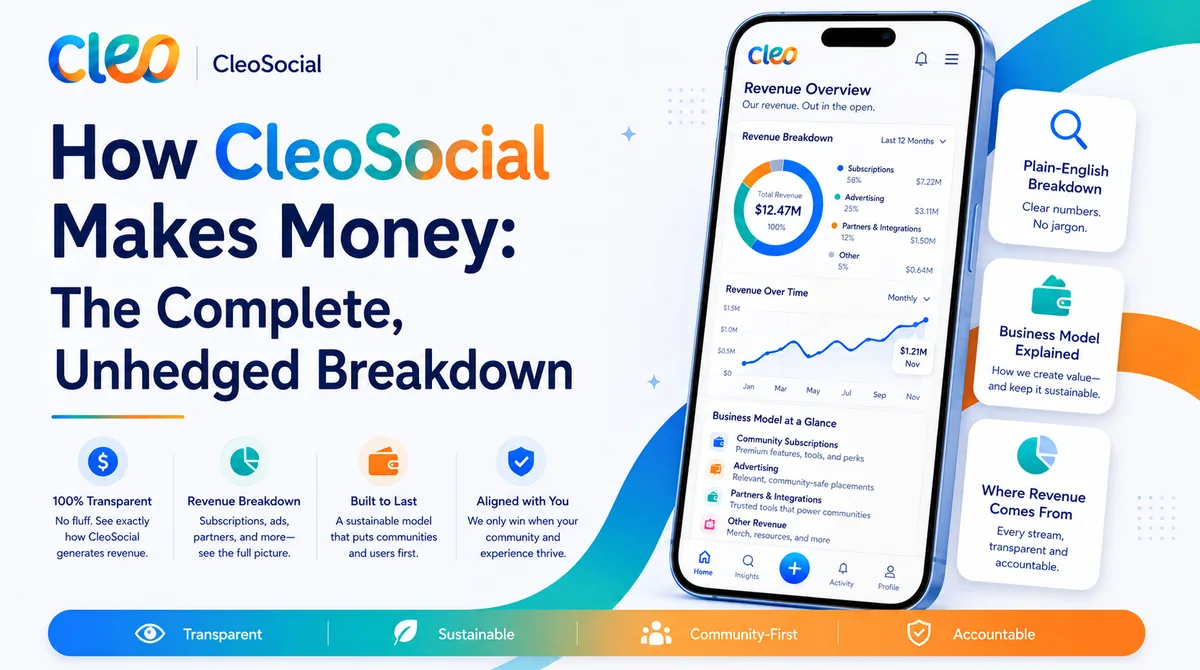
Table of Contents
How CleoSocial Makes Money: The Complete, Unhedged Breakdown
"How does this company make money?" is the question that explains every product decision you will ever encounter in an app — and it is the question most social platforms answer only in investor filings, where users rarely look. We think the users deserve the filing-grade answer in plain language. This is it.
No mystery-building: CleoSocial makes money from advertising. What makes the model worth a full post is the list of constraints the advertising operates under, the list of things we do not monetize, and the reasons a business would voluntarily accept both lists.
Revenue: Consent-Gated Advertising
CleoSocial is free — no subscription, no paid tier, no locked features. Revenue comes from clearly-labeled ads shown in the feed, under three rules we have documented in detail:
- Denied by default. Ad systems load nothing and process nothing until you explicitly consent. A Global Privacy Control signal counts as no. Decline and the advertising script simply never loads.
- Confirmed adults only. No confirmed age, no ad — the system suppresses rather than guesses.
- No feed influence. Ads occupy labeled slots. They have no vote in what surrounds them, what the AI rates, or what your ceiling admits — because the engagement-ranking machinery that would give them a vote does not exist here.
That is the entire revenue side. One stream, three constraints, all checkable.
What We Do Not Monetize (the More Important List)
A business model is defined as much by refused revenue as by earned revenue. The refusals:
Your time. The industry's core trade is engineering longer sessions to sell more impressions. CleoSocial ships Quiet Hours — a feature whose explicit purpose is fewer hours in the app — and runs no ranking algorithm to extend your scroll. Every silenced evening is revenue we declined on purpose.
Your ceiling. Intense content is the highest-engagement inventory in social media; an attention business surfaces it. Here, R-rated content is filtered by default and your ceiling is absolute. There is no premium tier that loosens it and no ad deal that overrides it.
Your exit. No streaks, no held data, no engineered regret. Leaving costs deleting an account. Cheap exits are expensive to offer — retention is the metric investors ask about — and we offer one anyway, because an app about user authority that trapped its users would be lying in its architecture.
Your profile. The feed does not need a behavioral dossier to rank content, because it does not rank content — your settings do. That removes the structural hunger for surveillance that attention platforms cannot escape. Ad-related processing happens only after your explicit consent, and the specifics live on the App Store privacy label and cleosocial.app, where you can read rather than trust.
Why Accept These Constraints? The Business Logic
Fair question — constraints this expensive need a better explanation than virtue.
The honest answer is positioning. The mainstream feed business is a commodity war over engagement, fought by giants with infinite inventory. CleoSocial's only durable asset is being the app where the user actually rules — the ceiling that holds, the evening that stays quiet, the model you can audit. Every constraint above is what maintaining that asset costs. Break one and we become a worse-funded version of the platforms we exist to be different from; keep them and we own a position none of the giants can copy without dismantling their own revenue engines.
In other words: we are not restraining the business model. The restraint is the business model.
What the Money Pays For
Transparency about revenue invites the follow-up: where does it go? Without turning this into an accounting document, the cost structure of a rated feed is worth understanding, because it explains why "just don't run ads" was never on the table.
Rating every post before feed delivery is real, recurring compute — the AI review runs on each post, at posting volume, forever. Serving video and images costs bandwidth at the same rates the giants pay, without the giants' scale discounts. And a growing platform carries the ordinary weight of storage, moderation review, security, and the engineering payroll that keeps settings actually holding the way this series keeps promising they do. Free-to-download does not mean free-to-run; the choice was never "ads or nothing," it was "ads under constraints, or a subscription wall, or quiet compromises."
We wrote about why the subscription wall lost — a feed that asks first should not be a luxury good — and the quiet-compromise route (sell data, loosen defaults, farm attention gently and hope nobody notices) is the one this entire post exists to foreclose. Ads under published constraints was the remaining honest option. That is the unglamorous version of the story, and we prefer it to a prettier one you could not check.
The Tension, Held in Public
We will name the uncomfortable part ourselves: ads and calm pull against each other. More users consenting, scrolling, seeing impressions — that is what pays for the servers. An app that also hands every user an off switch and an intensity ceiling is choosing to make its revenue harder on purpose, and anyone who claims that tension does not exist is selling something.
Our approach is to hold the tension where you can watch. The rules are published. The behavior is testable — decline consent and watch the network tab, set a Quiet Hours window and watch it hold. And this page is the standard to quote back at us if we ever drift. A model that survives auditing beats a model that survives only when unexamined; we have staked the company on that.
How to Verify All of This
We wrote ten questions to ask before downloading any social app — the money questions apply here with extra force:
- Who is the customer? You are, in the load-bearing sense: your settings govern the product; advertisers rent labeled slots inside a feed they cannot steer.
- Does the ad system respect a no? Test it: decline, and the ad script does not load at all.
- What would this app look like if revenue were winning? Looser default ceilings, dismissible Quiet Hours, a feed that fights your settings. Check for those in your first week; their absence is the audit passing.
- Where is this documented? cleosocial.app, the App Store listing and privacy label, and this post — kept current there precisely so blog posts like this one can age honestly.
Comparing Models at a Glance
| Model | Who pays | What the feed optimizes | Hidden cost to you | |---|---|---|---| | Attention-farmed (mainstream) | Advertisers | Your time in the app | Sessions, composition drift, surveillance appetite | | Subscription-only | You, monthly | Retention of subscribers | Price wall; consent feeds become a luxury | | Data brokerage | Buyers of profiles | Data capture surface | Your profile travels without you | | CleoSocial: consent-gated ads | Advertisers, inside constraints | Nothing — settings govern | The visible one: labeled ads, if you consent |
The last column is the argument in miniature: every model has a cost to the user, and the only honest question is whether the cost is visible and chosen. A labeled ad rendered after your explicit consent is the most visible, most chosen cost in the table. That is not the absence of a trade — it is the trade with the lights on.
The Bottom Line
CleoSocial earns revenue from consent-gated, adults-only advertising that is structurally locked out of running the feed — and declines to monetize your time, your ceiling, your exit, or a behavioral profile. The constraints are the strategy: the entire value of this company is being the platform where those sentences stay true.
You would ask a movie's rating before watching it. Asking a platform's business model before scrolling it is the same instinct, and you have just exercised it. Download CleoSocial free from the App Store — or run our own audit checklist against us first. We built for the users who check.
Ready for Social Media That Respects You?
CleoSocial puts you in control. Content ratings, time limits, and real connections. Free to use, always.

Continue Reading
What CleoSocial Knows About You — and How to Check
August 27, 2026
Does CleoSocial Show Ads? Yes — Here's Exactly How They Work
July 4, 2026