10 Questions to Ask Before Downloading Any Social App
A durable checklist for evaluating any social app before you give it your attention — with CleoSocial's answers included, so you can grade us with it too.
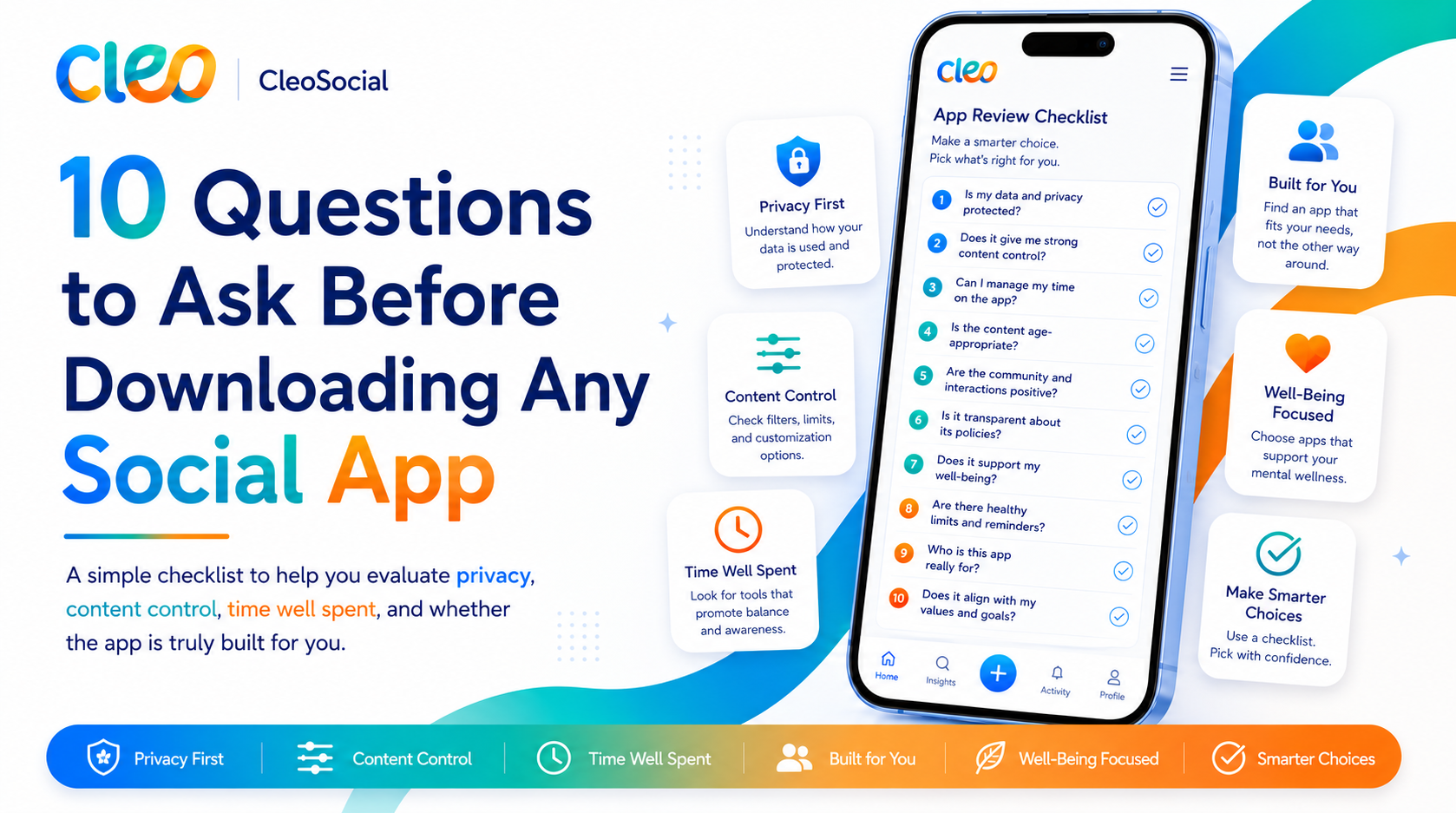
Table of Contents
10 Questions to Ask Before Downloading Any Social App
You research a phone before buying it. You check reviews before a restaurant. But most people install a social app — a thing that will occupy an hour of every remaining day of their life — on a friend's one-line recommendation.
Here are ten questions that reveal what an app will actually do with your attention, plus where to find each answer. And because a checklist from an app company is suspect until proven otherwise, we answer every question for CleoSocial as we go. Grade us with our own rubric; that is what it is for.
1. Who is the customer?
Follow the money. If advertisers pay, the feed's job is to maximize your time in it, and every downstream design choice inherits that goal. Find the answer in the app's privacy label and business model coverage — or notice its absence, which is also an answer.
CleoSocial: free and ad-supported — but the ads are denied by default until you consent, shown only to confirmed adults, and locked out of running the feed. The design choices that cost us ad impressions (no ranking algorithm, Quiet Hours) are the evidence that you remain the customer. Our full answer is here.
2. What decides what I see?
An engagement algorithm, a chronological timeline, your explicit settings, or some blend. This single fact predicts your daily experience better than any feature list. Apps rarely state it plainly; watch instead whether the default feed is full of accounts you never followed.
CleoSocial: your settings. Rating ceiling for intensity, Feed Control for topics. No engagement ranking exists.
3. Can I know how intense the content will get before I see it?
Almost everywhere, the answer is no — moderation is reactive, screens are inconsistent, and the first warning is your own eyes. Ask what mechanism, if any, sits between posting and your feed.
CleoSocial: every post is rated G, PG, PG-13, or R by the app's AI before it reaches any feed; R is filtered by default; you set the ceiling. This question is the reason the app exists.
4. What happens when I try to leave for the night?
Test it in week one: stop at 10 PM and watch what the app does. Notifications timed to your lapse hours, streaks that punish absence, and autoplay-on-open are all answers.
CleoSocial: Quiet Hours — you set a window, the app goes silent, and you can still open it whenever you choose. The app's honest answer to "can I leave?" is "you were never being held."
5. Do my preferences actually persist?
Everyone has tapped "not interested" and watched the same content return in new clothes. Ask whether your stated preferences are instructions the app obeys or signals an algorithm weighs against its own interests.
CleoSocial: instructions. Settings hold until you change them; there is no ranking system with competing incentives to renegotiate.
6. What does the privacy label say — and how long is it?
Open the App Store listing and read "App Privacy" before the screenshots. Compare what is "used to track you" against what the app functionally needs. A privacy label longer than the feature list tells you who the product is.
CleoSocial: check our listing and cleosocial.app — we keep specifics on the site rather than in posts that age, and we would rather you verify than take a blog's word. The posture: no dark patterns, and ad-related processing is denied by default until you explicitly consent, with GPC honored as a no.
7. Who is the implied user?
Read the app's own marketing. Is it speaking to you as a capable adult making choices, or as someone to be protected, monitored, or fixed? This predicts the product's whole voice — and whether using it will feel like control or like being managed.
CleoSocial: adults and young adults who love the scroll and want authority over it. Not a kids' product, not parental software, not therapy in app form. Who it fits — and who should skip it.
8. What does the app honestly not do?
Every product has this list; the question is whether the company will say it. Find a review or FAQ from the maker that names real limitations. If all you can find is "everything, for everyone," someone is optimizing for your download, not your fit.
CleoSocial: small-but-growing network, no groups or marketplace, not built for maximum creator reach. We publish the whole list, on purpose.
9. What is the exit cost?
Before entering, price the exit: does leaving cost you data, connections, purchased goods, or an identity you cannot take elsewhere? High exit costs quietly change how a platform treats you once you are in.
CleoSocial: the exit is deleting an app and an account. We hold nothing hostage — which is also why the answer to question 4 can afford to be honest.
10. What happens on the worst news day of the year?
The stress test. When something terrible happens in the world, what reaches your feed, and who decided? On most platforms, graphic footage travels faster than labeling and your mutes are always one vocabulary behind.
CleoSocial: news flows at the rating it earns; graphic material rates R and waits for your explicit opt-in. You stay informed at the ceiling you chose on a calm day — which is the right day to choose it.
Scoring the Big Platforms, Briefly
To show the checklist has teeth, here is how the mainstream feeds tend to score on the three heaviest questions — based on their own public design, verifiable by anyone in a first session.
What decides what I see? Instagram, TikTok, Facebook, X, Threads: an engagement-ranking algorithm, with a chronological or following view available but not favored. Bluesky: your chosen feeds, with assembly required. The pattern to notice is not that algorithms exist — it is that no mainstream feed makes your explicit settings the primary governor.
Can I know intensity in advance? Across every major platform: no. Sensitive-content screens exist and are reactive, partial, and unscaled — there is no ceiling to set anywhere. This question gets the most uniform failing grade of the ten, which is precisely why we built an app around it.
What happens when I try to leave? Dismissible reminders at best; engineered re-entry at worst. No mainstream platform ships a true off switch, because question 1 — who is the customer? — forbids it. The three questions turn out to be one question wearing different clothes: whose interests govern the feed?
Run the exercise yourself on your own apps; fifteen minutes of honest grading explains years of how scrolling has felt.
Two Questions We Left Off (and Why)
"Is the app AI-powered?" We left it off because it is the wrong axis. AI is in every feed you use — the question that matters is what the AI is for. An AI that ranks content to maximize your session time and an AI that rates content so you can set a ceiling are opposite technologies wearing the same acronym. Ask question 2 and question 3 instead; they capture what "AI-powered" obscures.
"How many users does it have?" Left off because it answers a different question than people think. Scale predicts whether your cousin is there; it predicts nothing about how the feed will treat you — the largest platforms score worst on questions 2 through 4 precisely because scale and engagement-optimization grew together. Ask about your people specifically (question 9's cousin: "who do I actually need here?") rather than using headcount as a proxy for quality.
A checklist is as much about what it refuses to ask as what it asks. Both omissions push the same direction: evaluate the relationship the app wants with your attention, not its specifications.
Using the Checklist
Three practical notes. First, answer from evidence, not marketing: privacy labels, first-session behavior, and what the company says when naming its own flaws. Second, weight questions 2, 3, and 4 highest — feed governance, intensity consent, and exit behavior shape daily life more than any feature. Third, apply it to the apps already on your phone, not just new candidates; incumbency is not an exemption, and the results usually surprise.
We wrote this checklist because CleoSocial scores well on it — that bias is disclosed and unavoidable. But the questions stand on their own, and an app that fails them fails them regardless of who is asking. If one of your current apps just failed several, you know what we would suggest trying next — and you now own the rubric to h
Ready for Social Media That Respects You?
CleoSocial puts you in control. Content ratings, time limits, and real connections. Free to use, always.

Continue Reading
The Attention Budget: A Practical Framework for Your Scroll
August 22, 2026
The 10-Minute Feed Audit: Test What Any Social App Really Shows You
August 13, 2026