Does CleoSocial Show Ads? Yes — Here's Exactly How They Work
Does CleoSocial show ads? Yes. The app is free and ad-supported — with three rules most platforms don't follow: denied by default, adults only, and ads never run the feed.
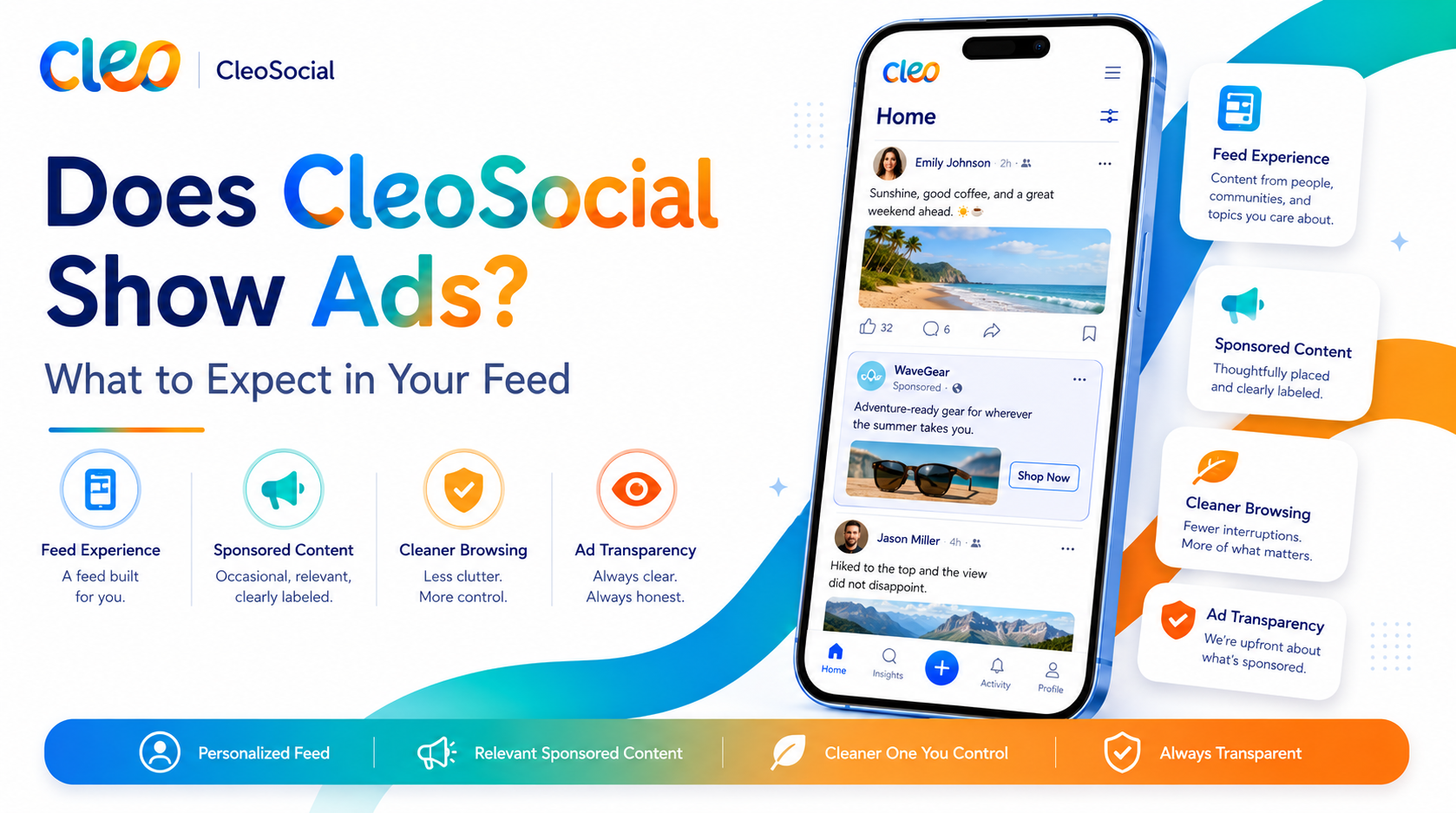
Table of Contents
Does CleoSocial Show Ads? Yes — Here's Exactly How They Work
Does CleoSocial show ads? Yes. CleoSocial is free — no subscription, no paid tier — and ads are part of how a free app keeps its lights on.
Most companies would bury that answer three paragraphs deep. We are leading with it, because the interesting part of the question was never whether an app shows ads. It is what the ads are allowed to do — to your data, to your feed, and to your time. On those three counts, CleoSocial's ads operate under rules most platforms do not follow, and this post lays out all of them, specifically enough that you can check our work.
The Three Rules
Rule 1: Denied by default. On most platforms, advertising machinery starts processing your data the moment the page loads — before you have been asked anything. CleoSocial inverts this. Ad systems are set to denied before anything loads, and the advertising script does not load at all until you explicitly consent. If you decline, or if your browser sends a Global Privacy Control signal, that is treated as a no — and no is the standing answer until you change it. The ask-first architecture you know from our content ratings applies to advertising too: consent, then content.
Rule 2: Adults only, fail-safe. Ads render only for viewers confirmed to be 18 or older. If your age is unknown, the system does not guess or default to showing — it suppresses the ad. An audience we cannot confirm is an audience we do not advertise to.
Rule 3: Ads fund the feed; they never run it. This is the rule that separates an ad-supported app from an attention-farmed one, so it gets its own section.
Ad-Supported vs. Attention-Farmed: The Distinction That Matters
Here is the part most people never get told directly. The damage ad-funded social media does was never really caused by the ads themselves — the rectangles in the feed are the least of it. The damage comes when the feed's ranking is conscripted into the ads business: when what you see, in what order, at what intensity, is optimized to maximize the time you spend looking, because time is inventory.
That conscription is what CleoSocial refuses. The feed's contents are governed by your settings — your rating ceiling, your Feed Control topics — not by an engagement-ranking algorithm. An ad appearing in your feed is clearly an ad, occupying its slot. It does not decide what surrounds it, it does not tune the feed to keep you scrolling past it, and it has no vote in what the AI rates or what your ceiling admits.
The cleanest evidence is a feature we ship at our own expense: Quiet Hours. Every hour the app spends silenced is an hour of ad impressions we chose not to have. We ship it anyway, because the app's premise — your feed, your rules, your time — has to outrank the revenue line to mean anything. An attention-farmed platform cannot make that trade. An ad-supported one can, and this one did.
What This Looks Like in Practice
Concretely, for a normal user on a normal day:
- If you never consent to ads processing, the advertising script does not load. Not "loads but respects you" — does not load.
- If you consent and you are a confirmed adult, you will see clearly-marked ads placed in the feed among posts. They are sized as cards, labeled as ads, and finite.
- Your rating ceiling, Feed Control settings, and Quiet Hours behave identically whether ads are on or off for you. No setting in the app trades your controls for revenue.
- Change your mind at any time; consent is a standing setting, not a one-time gate.
For current specifics — placements, policies, and anything that has evolved since this post — cleosocial.app and the App Store listing are the living sources. A model this simple should be easy to document, and it is.
Why Not Just Have No Ads?
The fair question, and it deserves a straight answer: because free matters, and free costs money.
CleoSocial's core belief is that a feed that asks first should not be a luxury good. A subscription-only model would make consent-based social media a product for people with a spare $60 a year — everyone else keeps the ambush feeds. Ads, run under the three rules above, are how the app stays free for the person who needs it most without becoming the thing it was built against.
We hold two commitments in tension and in public: the app stays free, and the feed stays yours. The rules in this post are what holding both looks like. If we ever fail at holding them, this page is the standard to quote back at us.
How This Fits the Product's Premise
A reasonable reader might ask whether ads — any ads — contradict an app whose pitch is user authority. It is the right challenge, and the answer is worth spelling out rather than waving at.
CleoSocial's premise was never "nothing commercial may exist near you." It was: nothing reaches you without your say. The ratings system enforces that for content — every post cleared against a ceiling you set. The consent architecture enforces it for advertising — no ad processing until you agree, no ads at all if we cannot confirm you are an adult, and a standing right to change your answer. The premise is intact; it simply turns out to apply to more than posts.
What would contradict the premise is the industry-standard version: ad systems that load before asking, feeds re-ranked to maximize exposure, age handled by assumption, consent buried in a settings page shaped like a maze. Each of those is a specific thing we built the opposite of, and each is checkable — in your browser's network tab, in the app's behavior when you decline, in what happens when Quiet Hours silences a session we could have monetized.
Skeptics are, sincerely, the audience this post was written for. The claims here are not vibes; they are implementation details, and implementation details can be audited. Hold us to them.
The Questions Worth Asking About Any App's Ads
We published ten questions to ask before downloading any social app; here are the ad-specific ones, with our answers on the record:
Does the ad system load before you consent? Most platforms: yes, by design. CleoSocial: no — denied by default, loaded only on explicit yes, GPC honored as no.
Can the ads influence what the feed shows you? Most platforms: the feed is the ad-delivery optimization. CleoSocial: no — ranking does not exist here; your settings govern content, and ads occupy labeled slots within it.
Who can be advertised to? Most platforms: anyone scrolling, with age handling of varying rigor. CleoSocial: confirmed adults only; unknown age means no ad, not a guess.
What does leaving cost? On attention-farmed platforms, the exit is engineered to be regretted — that is what your session data was for. Here, ads change nothing about the exit: delete the app and account, and nothing follows you.
Where is this documented? cleosocial.app, the App Store privacy label, and this post. Audit us; the architecture was built expecting it.
The Bottom Line
Yes, CleoSocial shows ads — consent-gated, adults-only, clearly labeled, and structurally locked out of running your feed. The app is free because of them, and the feed is yours despite them, and neither of those facts is hiding from the other.
You rate movies before you watch them. You should be asked before you are advertised to. On CleoSocial, you are — and that, not the absence of rectangles, was always the real answer to the ads question.
Download CleoSocial free from the App Store, or read the honest review first — the limitations section is real, and this post is the ads section of it.
Ready for Social Media That Respects You?
CleoSocial puts you in control. Content ratings, time limits, and real connections. Free to use, always.

Continue Reading
Does CleoSocial Protect Your Privacy? What to Know Before You Sign Up
June 11, 2026
What CleoSocial Knows About You — and How to Check
August 27, 2026