How CleoSocial Handles Political Content
Not by viewpoint, and not by topic ban. How the rating system treats political content the same way it treats everything else, and what that means for your feed.

Table of Contents
How CleoSocial Handles Political Content
This is one of the most common questions we get, and it deserves a direct answer rather than a vague one: CleoSocial does not rate or filter political content based on viewpoint, and it never will. What the rating system evaluates is the same for a political post as it is for anything else — intensity, graphic material, harassment, themes that would earn any post a higher rating regardless of subject. A calmly argued opinion piece and its opposite, on the same issue, get treated the same way. What changes a rating is not which side a post is on.
That distinction matters enough that it's worth walking through exactly how it works.
What Gets Rated, and What Doesn't
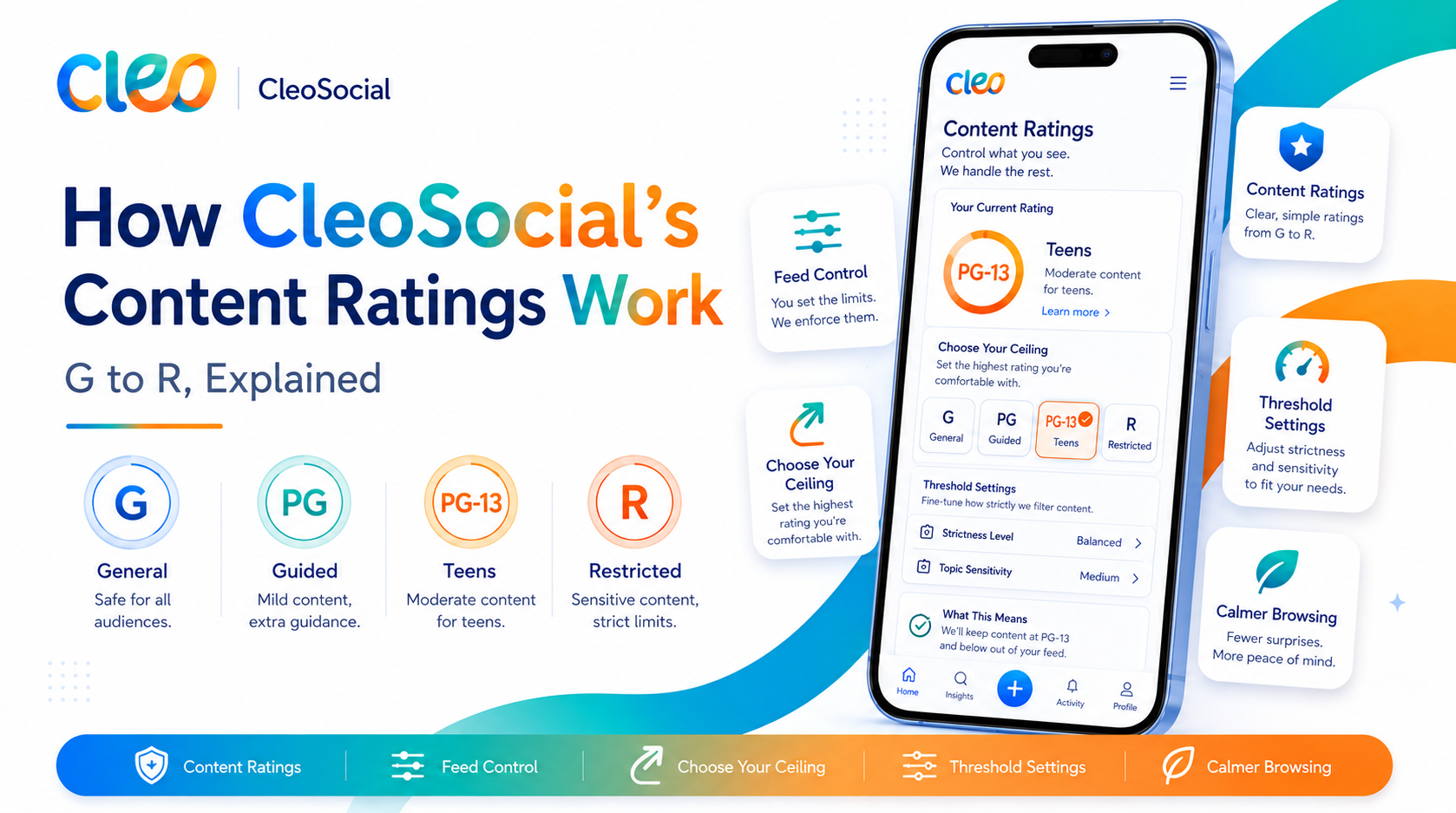
Every post on CleoSocial is rated G, PG, PG-13, or R by the same AI system before it reaches any feed, on the same criteria across every topic: graphic imagery, violence, harassment, sexual content, and similar intensity markers. A political post discussing policy in measured terms rates on the low end of that scale, the same as a calm post about any other topic would. A political post containing footage of violence, explicit threats, or targeted harassment rates higher, the same as a non-political post with the same content would. The system is evaluating what's in the post, not what position it argues.
What it explicitly does not evaluate: which candidate, party, or policy position a post supports. There is no mechanism in CleoSocial's rating system that treats one political viewpoint as inherently higher-rated than its opposite, and building one would contradict the entire premise of a ratings system that's supposed to be about content intensity, not content agreement.
Why This Distinction Is the Whole Point
A lot of platforms get accused, fairly or not, of moderating political content in ways that favor one side — sometimes through explicit policy, more often through the downstream effects of an engagement algorithm that happens to reward one kind of political content over another. CleoSocial's architecture sidesteps that problem structurally rather than through a promise: because ratings are about intensity rather than agreement, there's no lever in the system that could produce a viewpoint tilt even if someone wanted one. The rating an inflammatory post gets is a function of what's inflammatory about it, not who it's inflammatory toward.
What Feed Control Does With Political Content
Separately from ratings, Feed Control lets you set how much political content you want to see overall, the same way it works for any other topic — more of, less of, or somewhere in between. This is a volume dial, not a viewpoint filter. Turning political content down doesn't select for one perspective over another; it reduces the topic's overall presence in your feed, proportionally, across the full range of views represented in it.
Some users turn this dial down significantly, and that's a completely reasonable choice, especially during an intense news cycle. Others want more, not less, and Feed Control accommodates that just as directly. Neither choice touches the rating system underneath — a user with political content turned all the way up still only sees posts within their chosen ceiling, and a user with it turned down doesn't see the political content that remains treated any differently than they would otherwise.
Where the Line Actually Gets Drawn
The honest edge case worth naming: harassment and targeted threats rate as high-intensity content regardless of political framing, and that's a rating based on the conduct in the post — threats, targeted harassment, doxxing — not on the political opinion the conduct happens to be attached to. A post arguing a controversial position civilly and a post making the same argument through targeted harassment of an individual are not treated the same way, and shouldn't be. That's a content-conduct distinction, not a viewpoint distinction, and it's the same standard applied to non-political harassment too.
A Note on Election Season Specifically
Election periods concentrate political content in ways that test this system harder than an ordinary month does, and it's worth addressing directly rather than waiting for it to become a live question. During an election cycle, Feed Control's volume dial for political content becomes more useful than usual — not because the rating criteria change (they don't, ever), but because the sheer proportion of political content in circulation rises, and a user's chosen volume setting matters more when the baseline is higher. Ratings continue applying the same intensity criteria to campaign content as to anything else: a civil policy debate rates low regardless of which campaign it favors, and content crossing into targeted harassment or graphic material rates high regardless of which side it targets.
We also don't run any kind of "election integrity" content removal beyond the standard rating criteria — no separate fact-checking layer, no editorial judgment about which claims are true. That's a deliberate scope limit, not an oversight: a system built to rate intensity isn't the same system as one built to adjudicate factual accuracy, and claiming to do both well would overstate what this architecture actually does.
How CleoSocial Handles Political Content in Practice
During a contentious news cycle, a CleoSocial feed set at a PG-13 ceiling with political content turned to a moderate level in Feed Control will show calmly argued takes from across the spectrum, hold back graphic footage and targeted harassment regardless of which side it's attached to, and let a user adjust the volume of the topic without touching how any individual post gets treated. It's a narrower promise than "we'll show you the truth" or "we'll protect you from misinformation" — CleoSocial doesn't fact-check content or make editorial calls about which claims are correct. It's a promise about intensity and volume, which is a smaller claim, and one the system can actually keep.
The Bottom Line
Political content on CleoSocial gets exactly the same rating treatment as anything else, on the same criteria, applied the same way regardless of viewpoint — and Feed Control lets you decide how much of it reaches you at all, without that decision touching how any individual post gets rated. It's a narrower, more honest claim than most platforms make about political content, and it's the one the architecture can actually back up.
Download CleoSocial free from the App Store, or read how the rating system works in full for the mechanics behind everything above.
Ready for Social Media That Respects You?
CleoSocial puts you in control. Content ratings, time limits, and real connections. Free to use, always.