What the New Teen Social Media Safety Laws Actually Require
KOSA advancing in the Senate, California's addictive-features ban, New York's finalized rules, Meta's settlement terms. A plain-language guide to what's actually changing this fall.
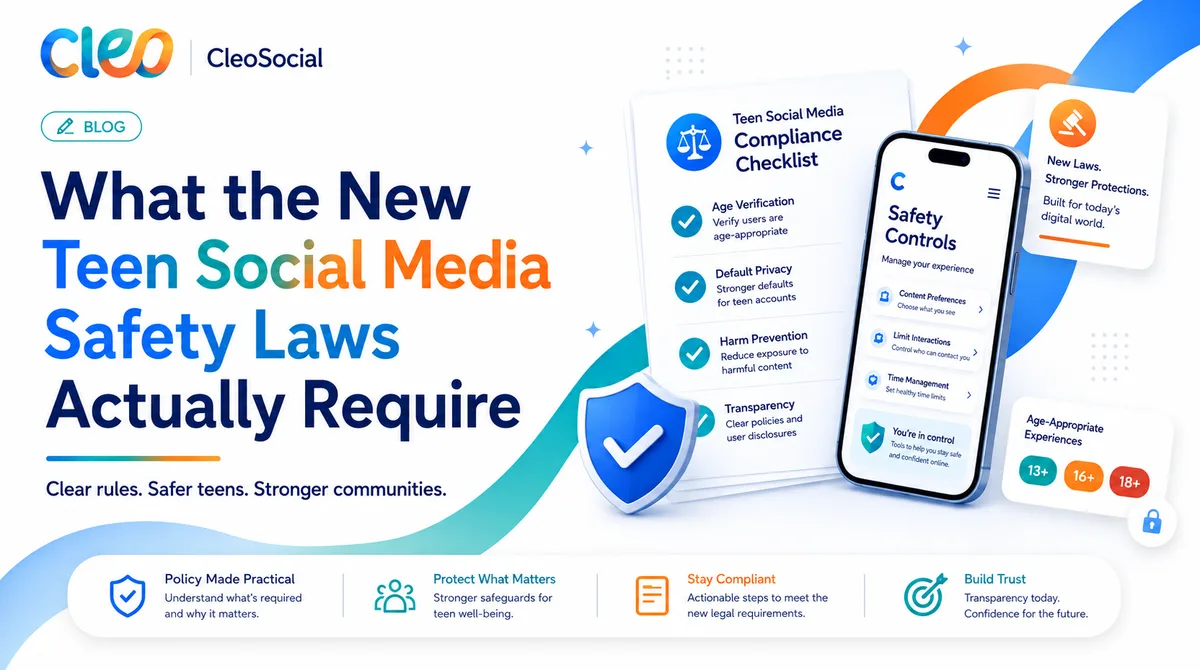
Table of Contents
What the New Teen Social Media Safety Laws Actually Require
A lot has happened in teen social media policy since spring, and most of it landed in a single stretch of this summer: the Kids Online Safety Act cleared a Senate committee, California moved to ban addictive feed features for anyone under 16, New York finalized the rules behind its SAFE for Kids Act, and Meta settled a multistate lawsuit for roughly $17 billion with terms that could reshape default settings across the industry. We track the ongoing coverage on our newsroom page, but the headlines alone don't answer the question most parents actually have: what does this mean for the app on my kid's phone this fall?
Here's a plain-language pass at the four developments that matter most, and what each one actually requires.
KOSA: Parental Controls and a Duty to Study Harm
The Kids Online Safety Act cleared the Senate Commerce Committee in August with 76 cosponsors — a genuinely bipartisan number in a Congress that agrees on very little. In its current form, KOSA would require platforms to provide parental controls and to study and report on how their products affect the wellbeing of minors. It has not become law yet; a House version passed in June with some of the strictest provisions removed, and the two chambers still need to reconcile their differences before anything reaches a president's desk.
What it would not do, in either version currently on the table, is mandate specific design changes like default time limits or algorithm restrictions — that level of specificity has mostly been left to states.
California: A Direct Ban on Addictive Features for Under-16s
California's bill is more concrete. Rather than requiring disclosure or parental tools, it directly prohibits platforms from providing "addictive" features — the specific mechanics identified in years of research as the ones that keep engagement highest and awareness lowest — to anyone under 16. If it becomes law as currently written, platforms serving California users would need to redesign parts of their product specifically for that age group, not just add a setting a parent could optionally enable.
This is the sharpest example yet of state law moving faster than federal law on the same problem, and other states are watching closely to see how enforcement actually plays out.
New York: Algorithmic Feeds and Nighttime Notifications, Off by Default
New York's SAFE for Kids Act took a different approach: rather than banning features outright, it requires platforms to turn off algorithmically personalized feeds and nighttime notifications for users under 18, unless a parent affirmatively opts back in. The final rules were published this summer and take effect January 25, 2027, giving companies about six months to comply. Violations carry civil penalties of up to $5,000 per instance.
The default-off structure here is worth noting because it's a genuinely different regulatory approach than California's outright ban — it assumes personalized feeds and late-night notifications are the problem, and it makes the safer state the default rather than requiring anyone to opt in.
Meta's Settlement: Industry-Wide Pressure Through Money
The largest single development, dollar-for-dollar, was Meta's roughly $17 billion settlement with a coalition of states over allegations that its apps were designed to be addictive to minors. What makes it relevant beyond Meta specifically: part of the settlement is structured so that a portion of the funds only unlock if competing platforms adopt similar safety measures — a built-in incentive for an industry-wide shift toward defaults like time limits and nighttime blocks, regardless of what any single law requires.
What This Wave of Laws Doesn't Settle Yet
It's worth being honest about what remains genuinely unresolved. A significant fight is playing out over federal preemption — whether a future federal law like KOSA would set a nationwide floor that states can build above, or a ceiling that overrides tougher state rules like California's and New York's. Earlier drafts of the House bill leaned toward the latter; the current version leans toward the former, but nothing is final, and the outcome will determine whether the strongest state protections survive federal legislation or get preempted by it.
There's also real, ongoing litigation testing whether some of these laws survive constitutional challenge at all, particularly around age-verification requirements and free-speech objections raised by civil liberties groups on more than one side of this debate. None of the four developments above should be read as fully settled law — they're the current state of a fast-moving picture, not a finished one, which is exactly why we keep the newsroom page updated rather than treating any single post as the final word.
What This Means If You're Setting Up an App This Fall
None of these four developments are fully in effect yet, and the honest answer is that most of what's changing is still working through legislatures, rulemaking, and settlement compliance timelines rather than showing up in an app update this week. But the direction is consistent across all four: default-off algorithmic feeds for minors, time limits with teeth, and nighttime blocks that don't require an opt-in to work.
That's a direction CleoSocial's design already leans into rather than a change it needs to make. Content ratings apply to every post before it reaches any feed, Quiet Hours enforces a nighttime boundary without requiring daily willpower, and Feed Control is built on topics a user states rather than behavior an algorithm infers — the closest thing to "not personalized by default" a feed can be while still being useful. None of this is a regulatory response; it predates most of these bills. It's worth saying plainly anyway, because the direction of the law and the direction of the product happen to point the same way.
What to Watch For in Teen Social Media Safety Laws
If you're a parent making decisions this fall rather than tracking legislation for its own sake, three practical markers matter more than the bill numbers: whether an app's algorithmic feed is on or off by default for a minor's account, whether nighttime notifications require an opt-out or an opt-in, and whether the platform's own reporting shows a real ceiling on daily use rather than a soft nudge. Ask those three questions of any app before a download, and the current wave of legislation becomes a lot easier to translate into an actual decision.
Download CleoSocial free from the App Store, or read our family setup guide for a fuller walkthrough of what to look for regardless of which state your family lives in.
Ready for Social Media That Respects You?
CleoSocial puts you in control. Content ratings, time limits, and real connections. Free to use, always.