6 Myths About CleoSocial, Corrected by the People Who Built It
It's censorship. It's for kids. It's anti-social-media. Six myths about CleoSocial we hear constantly — corrected plainly, with the receipts linked.
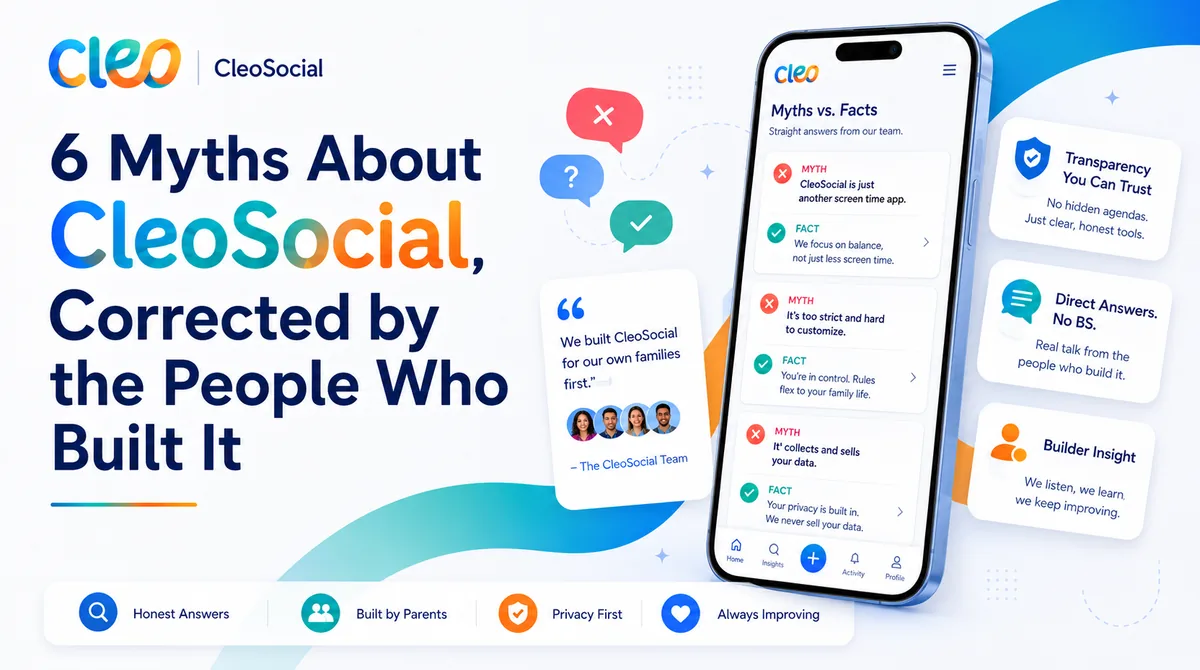
Table of Contents
6 Myths About CleoSocial, Corrected by the People Who Built It
An app built on an unusual premise collects mythology fast. Some of it comes from honest pattern-matching — "ratings" sounds like one familiar thing, a calm feed sounds like another — and some from the categories the industry has trained everyone to sort apps into. Either way, we hear the same six misreadings constantly, and each one maps CleoSocial onto something it specifically is not.
Here they are, corrected plainly. Where the correction rests on a checkable fact, the link is right there.
Myth 1: "Rating content is just censorship with better branding."
The correction: censorship removes content and removes your choice with it. A rating adds information so your choice means something. Nothing on CleoSocial is deleted by your ceiling — a post rated R exists, is visible to every user whose settings allow R, and is simply not routed into feeds whose owners set a lower limit. Your ceiling shapes your feed and no one else's.
The movie analogy is not a marketing flourish; it is the actual logic. An R rating at the cinema never censored a film — it told you what you were walking into. Fifty years of that system and nobody calls it censorship, because informed choice is the opposite of imposed silence. The full argument.
Myth 2: "G, PG, PG-13 — so it's a kids' app."
The correction: CleoSocial is built for adults and young adults, full stop. The rating vocabulary is borrowed from movies because adults already trust it — the same reason airlines borrowed traffic-light colors — not because the audience is children. Notice what the borrowed system is for here: letting a grown person set their own ceiling, including all the way up. A kids' app locks the dial; this one hands it to you.
The confusion is understandable and we police it hard on our own side — it is why our marketing shows adults making choices, not families being protected. Who the app is actually for.
Myth 3: "It's another anti-social-media app for people who want to quit."
The correction: quitters do not need a new social app — that market is served by deletion, which is free. CleoSocial is for people who love the scroll and refuse to quit: the users who post, react, discover, and follow creators daily, and are simply done being ambushed while doing it. The app's fourth pillar is literally "still social."
The tell is in the design. An anti-social-media product would make usage feel guilty — streak-breakers, time-shaming, lectures. CleoSocial ships none of that; Quiet Hours itself is a boundary you set, not a judgment the app renders. Scrolling you chose is the product, not the pathology.
Myth 4: "A calm feed means an empty, boring feed."
The correction: calm and empty are different properties, and the conflation flatters the wrong thing. What makes mainstream feeds feel "full" is engagement optimization — intensity injected because reactions are revenue. Remove the injection and what remains is not emptiness; it is your actual interests at your chosen intensity, which most people discover is what they wanted the fullness to be.
The honest part of this myth is network size: CleoSocial is growing, and our review says so plainly. But that is "newer," not "boring" — and the fix is time and invitations, not re-adding the ambush.
Myth 5: "The AI must be reading everything and deciding what's good for you."
The correction: the AI rates; you decide. The system reviews posts before feed delivery and attaches a G-to-R label — the same job a movie ratings board does, performed by software at feed speed. It holds no opinion about what you should want, sets no agenda, and its every judgment is printed on the post where you can audit it. Compare that with the mainstream arrangement, where an unseen ranking system decides what you see and never shows its reasoning. One of these is the transparency concern; it is not the one with visible badges.
Is the rating AI perfect? No, and we have never claimed so — gray-zone posts exist. But "imperfect and auditable" is a different animal from "opaque and optimizing against you."
Myth 6: "Free plus ads means you're the product, same as everywhere."
The correction: the "you are the product" critique was never really about ads existing — it was about feeds being re-engineered to farm attention for them. That second step is the harm, and it is the step CleoSocial structurally cannot take: there is no ranking algorithm for ad revenue to conscript. The ads that fund the app are denied by default until you consent, shown only to confirmed adults, and locked out of feed decisions — and features that cost us impressions, like Quiet Hours, ship anyway.
Skepticism here is healthy; we wrote a ten-question audit framework so you can apply it to us with rigor instead of vibes.
(A seventh candidate we retired: "the ratings are done by underpaid moderators." Nobody who believes it stays wrong for long — the AI's before-the-feed rating is the system's whole timing story — but its existence is a useful reminder that myths import from the platforms people came from. Content moderation's real labor controversies belong to the reactive model; a proactive rating architecture has different failure modes, which we would rather be criticized for accurately.)
The Category Question Underneath All Six
If you want a single key that unlocks every myth at once, it is this: CleoSocial does not fit the existing app categories, and each myth is an attempt to force the fit. Content-moderation tool? No — moderation decides what may exist; ratings decide what you admit. Parental-control software? No — the person setting the ceiling is the person scrolling. Wellness app? No — nothing here treats you as a patient. Anti-tech protest? No — it is more social media engineering, not less, aimed at the user's side of the table for once.
The nearest true category is older than apps: consent infrastructure, the family of systems — movie ratings, food labels, content advisories — that societies build so people can make informed choices about what they take in. Nobody calls a nutrition label a diet, censorship, or a children's product. Feeds simply never had their label system until now. Read the myths again through that lens and each one dissolves into the category error it always was.
Two Myths We Half-Deserve
Fairness cuts both ways, so here are two circulating claims that contain something true, corrected only where they overshoot.
"The network is tiny." Half true. It is growing, which is different from tiny and different from grown. If your entire social media life is keeping up with specific people, our own fit guide tells you to wait or run the two-app split. The overshoot is concluding that a growing network has no value: the feed's core promise — nothing above your ceiling, ever — works identically at any scale, and browsing-first users get full value on day one. Judge the app by which kind of user you are, not by headcount.
"They talk about calm a lot for a company that now runs ads." We understand the eyebrow. The answer is not that the tension is fake — it is that we manage it in public: consent-gated, adults-only, structurally fenced out of feed decisions, documented in a post whose title starts with 'Yes'. A company hiding that tension would deserve the myth. We would rather hold it where you can watch.
Why Myths Stick, and What to Do With This Page
All six myths share one root: they map a new architecture onto a familiar category — ratings onto censorship, calm onto quitting, free onto farming. Categories are how people think, and the burden of precision is ours, not yours. That is what this page is for: the next time someone sorts CleoSocial into a box it does not belong in, the correction is one link long.
And if you are the skeptic yourself: good. Every correction above is checkable — in the app's behavior within your first session, in the settings that hold, in the badges on the posts. Fifteen minutes of setup tests all six myths at once.
Download CleoSocial free from the App Store — and if you find a seventh myth in the wild, we would sincerely like to hear it.
Ready for Social Media That Respects You?
CleoSocial puts you in control. Content ratings, time limits, and real connections. Free to use, always.

Continue Reading
CleoSocial Ratings vs Instagram's Sensitive Content Control
July 30, 2026
How CleoSocial's Content Ratings Work: G to R, Explained
July 2, 2026