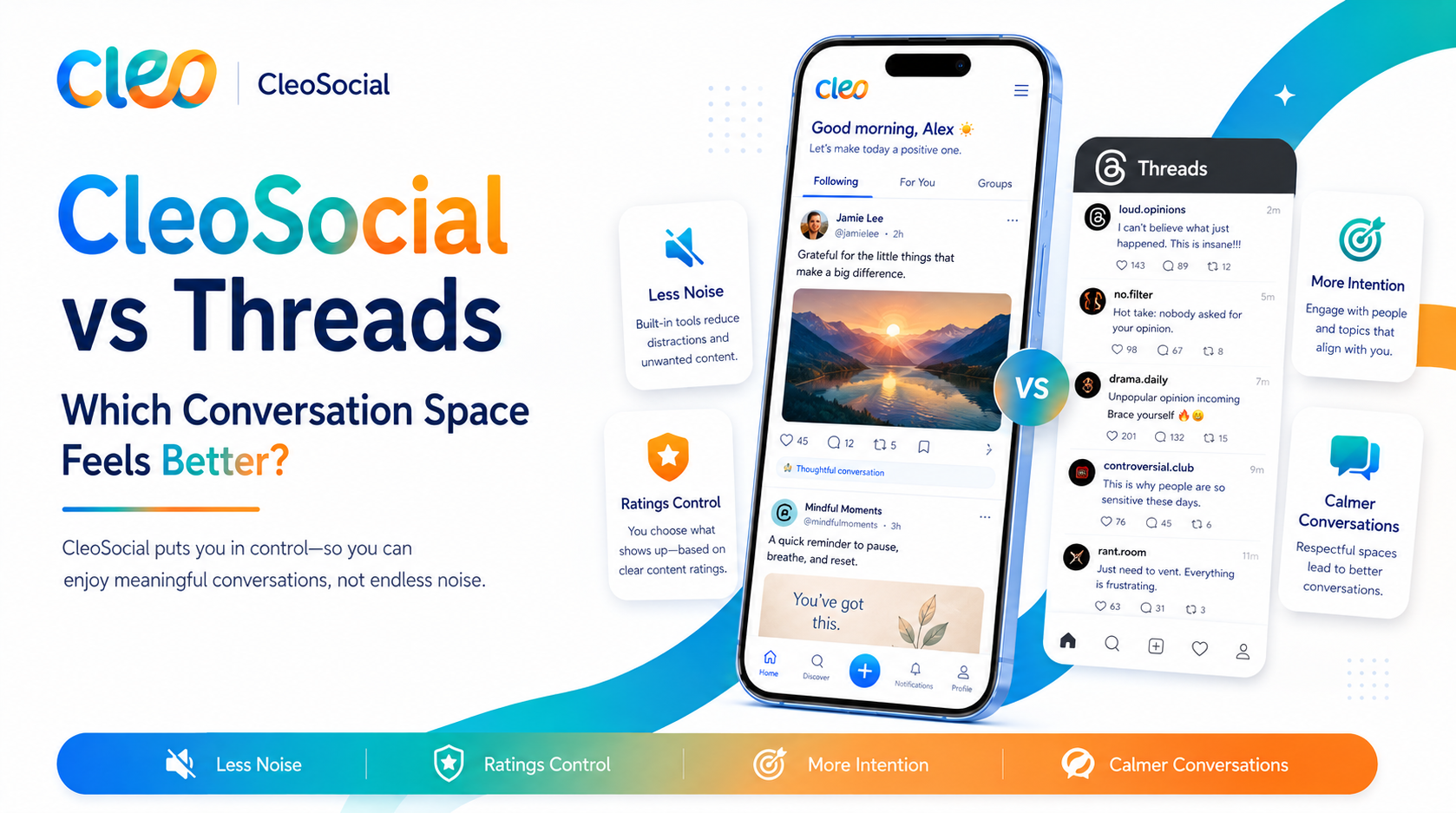
CleoSocial vs Bluesky: Two Different Answers to the Same Problem
CleoSocial vs Bluesky compared. Both apps answer the broken mainstream feed — one with open protocols and custom feeds, one with ratings and your ceiling.
Table of Contents
CleoSocial vs Bluesky: Two Different Answers to the Same Problem
CleoSocial vs Bluesky is the rare comparison where both apps agree on the diagnosis. Both were built by people who think the mainstream algorithmic feed is broken: opaque ranking, engagement incentives, users along for the ride. Where they disagree — completely — is on the cure.
Bluesky's answer is openness: an open protocol, custom feeds you can choose or build, moderation you can layer and swap. CleoSocial's answer is consent: every post rated before you see it, a ceiling you set, quiet hours you control. One hands you infrastructure; the other hands you a dial.
Which cure fits depends on what, exactly, hurt you about the old feeds. Here is the honest breakdown.
The Basic Difference
Bluesky is a text-first public platform on the AT Protocol. Its defining feature is choice of feeds: alongside a chronological Following feed, you can subscribe to community-built custom feeds, apply stackable moderation services and labelers, and in principle take your identity elsewhere on the protocol. It is the tinkerer's vision of social media: nothing forced, everything composable.
CleoSocial is a personal social feed where the defining feature is content ratings: the app's AI rates every post G, PG, PG-13, or R before it reaches any feed. R is filtered by default; you set the ceiling; Feed Control tunes topics; Quiet Hours silences the app on your schedule. It is the settled vision: decide your terms once, then just scroll.
Feed Control: Composable vs. Configured
Bluesky: you escape the algorithm by choosing your feeds — and the choosing is real work. Finding good custom feeds, subscribing to labelers, tuning moderation lists: the power is genuine and the learning curve is too. Bluesky rewards users who enjoy assembling their experience. Its defaults, meanwhile, are a fairly raw public timeline; the curation is opt-in labor.
CleoSocial: you escape the algorithm because there isn't one — the feed runs on your settings from the first session. Ceiling, topics, hours: three dials, fifteen minutes, done. There is nothing to assemble and correspondingly less to compose. CleoSocial rewards users who want the result of curation without adopting curation as a hobby.
The tell: if the phrase "you can build your own feed" excites you, that is a Bluesky instinct. If your reaction is "I just want to set it and scroll," that is a CleoSocial instinct. Neither is wrong; they are different relationships to tooling.
Content Intensity: Labels You Assemble vs. Ratings Built In
Bluesky: moderation is composable — platform baseline plus optional labelers plus your own lists and filters. Powerful, and again: assembly required. Out of the box, a raw public feed can serve you anything the network is discussing, including the heated and the graphic, until you have built up your filter stack. The burden of anticipating what will hurt is largely yours.
CleoSocial: intensity handling is the chassis, not an accessory. Every post is rated before the feed, uniformly, on one four-level scale you already understand from movies. A graphic video rates R and never reaches a PG-13 ceiling — no labeler subscriptions, no list maintenance, no seeing it once to filter it next time. The system is less flexible than Bluesky's (you cannot swap in a third-party rating philosophy) and far more complete by default.
This is the deepest difference between the apps: Bluesky gives you moderation as a toolkit; CleoSocial gives you consent as a guarantee.
Boundaries
Bluesky: no meaningful built-in usage boundaries — it is a timeline, and stopping is your business.
CleoSocial: Quiet Hours ships in the box: a window you set when the app goes silent, no notifications, no pull, never locked out. If evenings are where your scroll leaks, this is a category of feature one app has and the other does not.
What Bluesky Does Better
The honest list:
- Public conversation and reach. Bluesky is a town square with real cultural presence; if you want strangers replying to your takes, it delivers.
- The open protocol. Account portability and a composable ecosystem matter, both practically and as principle. CleoSocial offers nothing equivalent.
- Power-user ceiling. Custom feeds and stackable moderation can produce experiences no packaged app matches — if you invest the effort.
- Network momentum in text-discourse circles. Journalists, developers, academics: if your people are anywhere off the mainstream platforms, they may be there.
If those pull you, Bluesky is a genuinely good answer to the broken feed. It is just answering a different user.
The Question That Decides It
Both apps return control; the difference is the shape control takes. So ask yourself: when the old feed hurt you, was the injury about ownership or about exposure?
If it was ownership — resentment that a corporation's black box decided your information diet — Bluesky's open, composable model speaks directly to that wound. You will happily spend a weekend building your feed stack, and the building will itself feel like the victory.
If it was exposure — the video you cannot un-see, the ambush between a friend's photos and a recipe, the bracing before every scroll — then composability is beside the point and may even feel like homework. What you want is the guarantee: nothing above your ceiling reaches you, ever, starting now. That is CleoSocial's entire architecture, and no amount of labeler-stacking on an open protocol quite reproduces it, because there the default is open and safety is assembled, while here the default is rated and openness is opt-in.
Ownership wound → Bluesky. Exposure wound → CleoSocial. Both → read on.
Running Both
These two coexist naturally, arguably better than any other pairing in this series. Bluesky takes the public-discourse job: opened deliberately, for conversation, the way you would visit a forum. CleoSocial takes the default-scroll job: the reflexive open, at your ceiling, with your evenings protected. The jobs barely overlap, and the failure mode — giving your habit hours to the raw public timeline and your leftovers to the configured feed — is the same one we flagged in the Threads comparison: backwards.
A Week on Each, Sketched
A week on Bluesky starts with assembly. You find the starter packs, follow fifty accounts, try three custom feeds, subscribe to a labeler someone recommended. By Thursday your timeline is good — genuinely yours, in the built-it-yourself sense — and you have opinions about feed generators. The failure mode, if it comes, is either the raw default timeline souring you in the first hour, or discovering that maintenance never fully ends: new controversies route around old filters, and the toolkit asks for ongoing attention the way any good workshop does.
A week on CleoSocial starts with seven settings and then, mostly, nothing — which is the product working. The ceiling holds. The feed reflects the topics you set. Quiet Hours takes the evenings. By Thursday the rating badges have become furniture and you notice mainly that you have stopped bracing. The failure mode, if it comes, is quiet: a growing network means discovery does more work than reunion, and if you arrived needing your specific people, you will feel their absence before you feel the calm.
Same week, opposite textures: one hands you a workshop, the other a finished room. Knowing which you would rather walk into on a Tuesday night is most of the answer.
CleoSocial vs Bluesky: The Short Version
| | Bluesky | CleoSocial | |---|---|---| | Answer to the broken feed | Open protocol, composable feeds | Ratings + your ceiling, built in | | Content intensity | Labelers/lists you assemble | Rated G–R before the feed; R filtered by default | | Effort model | Power through tinkering | Power through settings | | Boundaries | None built in | Quiet Hours | | Public discourse | Strong, growing | Not the focus | | Portability | AT Protocol, portable identity | No equivalent | | Free | Yes | Yes |
The Bottom Line
Bluesky rebuilds social media as infrastructure you can own; CleoSocial rebuilds it as an experience you can govern. If assembling your feed sounds like freedom, go there — sincerely. If being asked before the feed shows you things sounds like freedom, this is the app that made that the entire point.
Download CleoSocial free from the App Store — or start with who the app fits and who it doesn't if you are weighing more than these two.
Ready for Social Media That Respects You?
CleoSocial puts you in control. Content ratings, time limits, and real connections. Free to use, always.

Continue Reading
CleoSocial vs Snapchat: Disappearing Messages or a Feed You Can See Coming?
September 1, 2026
CleoSocial vs Reddit: Chosen Communities or a Governed Feed?
August 4, 2026