CleoSocial vs Snapchat: Disappearing Messages or a Feed You Can See Coming?
Snapchat solved for permanence anxiety with messages that vanish. It never solved for what shows up on Discover and Spotlight before you can look away. A fair comparison of two different fixes.
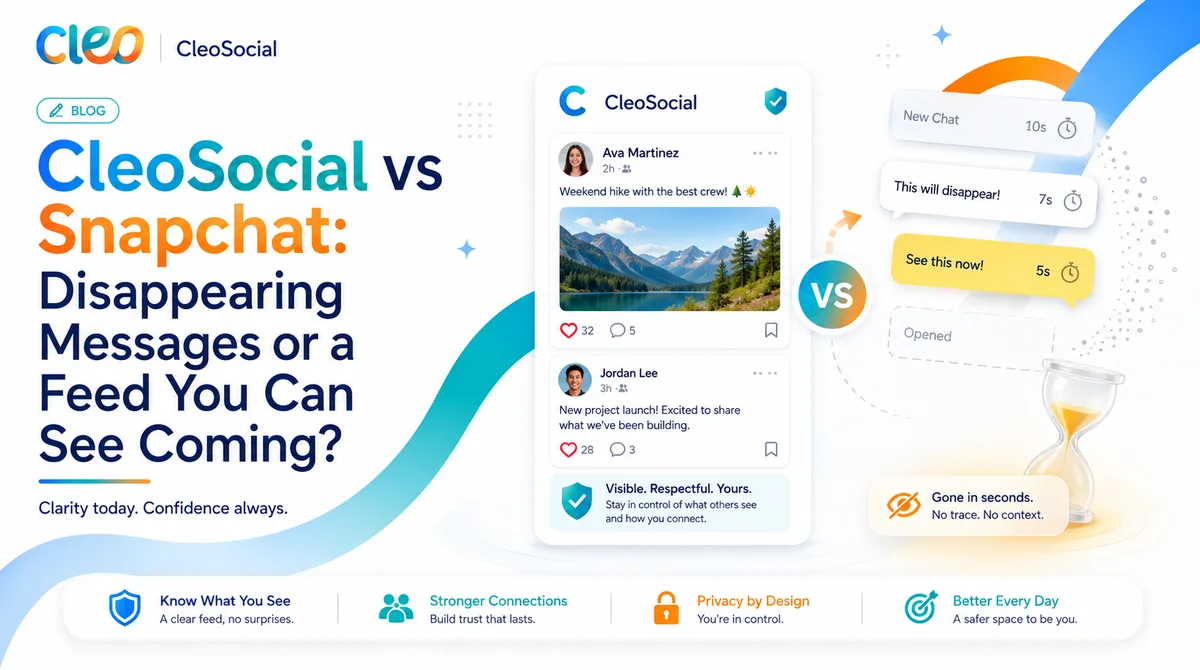
Table of Contents
CleoSocial vs Snapchat: Disappearing Messages or a Feed You Can See Coming?
Snapchat solved a real problem before almost anyone else named it. Messages that disappear by default meant a generation could send an ugly selfie or a bad joke without it becoming a permanent record — a genuine answer to the anxiety of a screenshot-everything internet. That part of Snapchat's design has aged well and deserves the credit.
The comparison with CleoSocial is not about messaging, though. It is about the other half of the app: Discover and Spotlight, the ranked feeds sitting one tab over from the friends list, built on the same engagement logic as every other algorithmic feed. Ephemerality solved one anxiety. It left the ambush problem completely untouched.
Where Snapchat's Answer Works
Between friends, disappearing-by-default is still a smart default, and Snap Streaks turned daily contact into a habit loop that, unlike most engagement mechanics, is at least pointed at an actual relationship rather than a stranger's content. For close friend groups who want a low-stakes, low-permanence way to stay in touch through the day, nothing else quite replicates the texture of a Snap.
Where the Model Breaks
Disappearing does not mean unrated. A message vanishing after it is viewed has nothing to do with what is in it. Snapchat's ephemerality is a retention policy, not a content policy — and it was never built to answer the separate question of intensity.
Discover and Spotlight are ranked feeds like any other. Once you leave the friends tab, Snapchat runs the same playbook as the platforms it gets compared against: publisher content and short-form video ranked for engagement, surfaced by an algorithm optimizing watch time. The disappearing-message reputation does not extend here. What shows up on Spotlight is exactly as unrated and exactly as capable of ambush as any other short-video feed.
Snap Map adds a dimension most feeds don't have. Location sharing, even limited to friends, is a different category of exposure than content intensity — and it is opt-in in theory but socially pressured in practice for teens who don't want to look like they're hiding something. It's worth naming as its own consideration, separate from the feed conversation this post is mostly about.
CleoSocial's Different Answer
CleoSocial doesn't have disappearing messages, and it isn't trying to solve the same anxiety Snapchat solved. What it governs is the feed itself: every post is rated G, PG, PG-13, or R by the app's AI before it reaches anyone, R is filtered by default, and you set a ceiling that holds across the entire feed — no separate "Discover" surface with different rules, because there is only one surface.
What CleoSocial doesn't have is Snapchat's specific chat-and-streak culture. If your use of Snapchat is mostly the friends tab — quick photos, streaks, ephemeral check-ins — CleoSocial isn't built to replace that, and it wouldn't be honest to claim otherwise.
The Streak Problem, Specifically
Streaks deserve their own honest look, because the mechanic is cleverer than it first appears. A Snap Streak rewards daily contact with a specific friend, tracked with a visible counter that resets to zero if a single day is missed. For close friends who'd talk daily anyway, it's a pleasant bit of gamification on top of a real relationship. For everyone else, it quietly becomes an obligation: opening the app isn't a choice made from wanting to connect, it's a chore performed to avoid losing a number. Surveys of teen Snapchat users have long found streak anxiety to be one of the most commonly cited sources of stress tied to the app — not the content, the counter.
CleoSocial doesn't have an equivalent mechanic, and that's a deliberate choice rather than an oversight. Any feature that converts a relationship into a maintained score creates pressure that has nothing to do with whether the relationship itself is going well, and a governed feed built around reducing ambush and reclaiming attention would be working against itself by adding a different kind of compulsion loop through the back door.
CleoSocial vs Snapchat in One Scenario
A 15-year-old opens Snapchat between classes. The friends tab is exactly what it should be — three Snaps from close friends, gone once viewed. Then a thumb-swipe lands on Spotlight, and the next four videos are ranked purely on what kept the last million viewers watching longest, with no rating attached and no ceiling to catch them.
On CleoSocial, the equivalent swipe stays inside whatever ceiling was set during setup. There's no second feed with different rules waiting one tab away. The friends-and-streaks use case Snapchat built well simply isn't part of the trade being made.
Side by Side
| | Snapchat | CleoSocial | |---|---|---| | Core design | Ephemeral messages between friends | A feed you govern | | Content rating | None on Discover/Spotlight | G, PG, PG-13, R on every post | | Ranked feed | Yes (Discover, Spotlight) | Yes, but rated first | | Location sharing | Snap Map (opt-in, socially pressured) | Not a feature | | Boundaries by time | None built in | Quiet Hours | | Free | Yes (ads; Snapchat+ optional) | Yes (consent-gated ads) |
Who Should Use Which
Snapchat, clearly: your use case is genuinely the friends tab — daily low-stakes contact with people you know, where ephemerality is the actual feature you want.
CleoSocial, clearly: you or your family spend real time in Discover or Spotlight, and the unrated, algorithm-ranked half of the app is where the ambushes and the lost hour keep happening.
Both, sensibly: plenty of households already run this split without naming it — Snapchat for the friend group, something governed for the open scroll. If you're setting this up for a teenager this fall, our guide to parental controls that don't feel like spying covers how to have that conversation without it becoming a fight.
The Bottom Line
Snapchat earned its reputation solving a problem CleoSocial doesn't try to touch — the anxiety of permanence between friends. But Discover and Spotlight are not covered by that reputation, whatever the brand halo suggests. The two apps are answering different questions, and knowing which one you're actually asking is the whole trick.
Download CleoSocial free from the App Store, or run the five-minute fit test first if you're unsure which question you have.
Ready for Social Media That Respects You?
CleoSocial puts you in control. Content ratings, time limits, and real connections. Free to use, always.

Continue Reading
CleoSocial vs Reddit: Chosen Communities or a Governed Feed?
August 4, 2026
CleoSocial vs Bluesky: Two Different Answers to the Same Problem
July 23, 2026