Is CleoSocial Good for College Students?
Incoming freshmen are building entire social lives online before they set foot on campus. What that means for the feed they're building it on, and where CleoSocial fits.
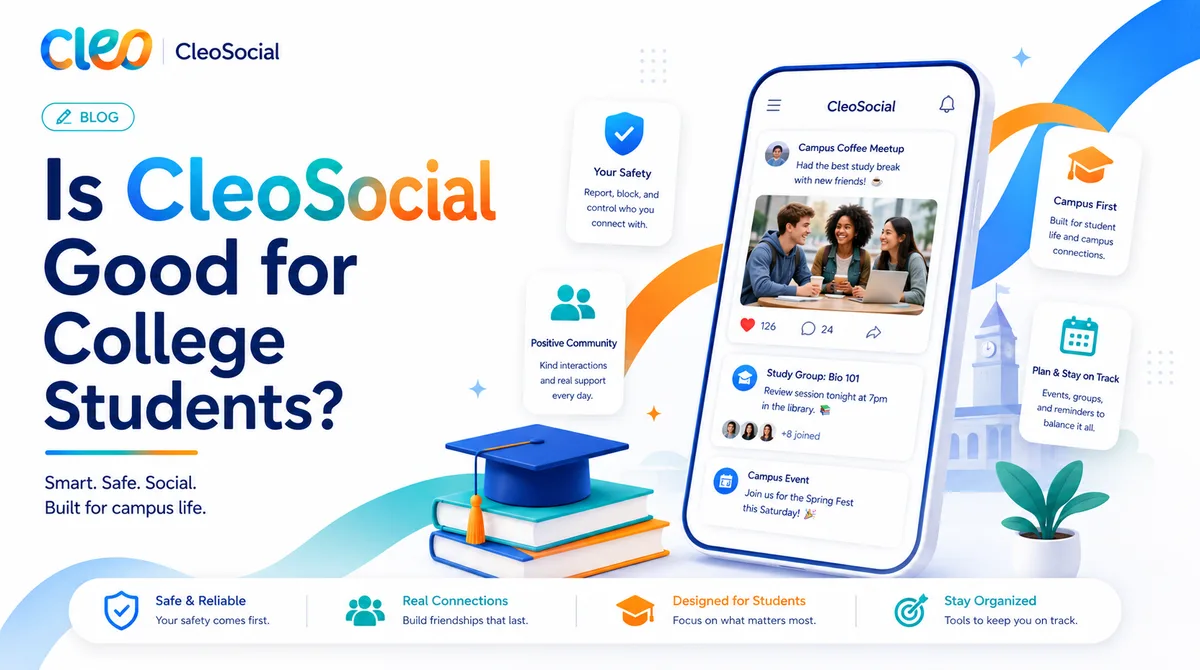
Table of Contents
Is CleoSocial Good for College Students?
A real shift has happened in how incoming college students arrive on campus: many now spend the summer before freshman year building an entire social circle online first, through class-year group chats, dorm hashtags, and mutual-friend introductions, so that move-in day is less a leap into strangers and more a meetup with people already half-known. It's a genuinely useful use of social media, and it puts a lot of weight on the feed doing the introducing.
The question worth asking before that summer starts: what kind of feed do you want doing that work?
What Makes the College Use Case Different
Most social media advice assumes a stable life with an established network, and college is the opposite of that on purpose — a deliberately fresh start where a huge share of the year's social outcomes get decided in the first few weeks. Three things follow from that.
The stakes of a bad feed are higher, briefly. An ambush post or a wasted hour costs more during a compressed window where first impressions, roommate matches, and club sign-ups are all happening at once than it does in an ordinary month.
Discovery matters more than usual. Finding the right clubs, classes, and people is the actual job the feed is being asked to do, which means Feed Control — telling the feed what you want more of — gets used harder and earlier than it typically does for an established user.
The network gap is real and worth naming honestly. Any new platform faces the same limit for a student arriving on campus: it can't manufacture a network that doesn't exist yet. If a school's incoming class is coordinating primarily on one specific app, that's where the coordination happens, full stop, and no feed architecture changes that math.
Is CleoSocial Good for College Students? Where It Fits
For the parts of the college transition that are about your feed rather than the class's coordination hub — the ambient scroll during a stressful orientation week, the late-night doomscroll in an unfamiliar dorm room, the hours that used to disappear into an algorithm optimized for something other than your wellbeing — a governed feed does what it does anywhere else: a ceiling that holds, Feed Control tuned to genuinely new interests, and Quiet Hours that matter more than ever against a schedule with no parents enforcing bedtime anymore.
Where it doesn't fit: if your entire incoming class organized itself on one specific platform before move-in, CleoSocial isn't going to replace that coordination function, and it would be dishonest to pretend otherwise. The two-app split — the coordination app for the coordination, a governed feed for the open scroll — tends to be the honest answer for students more than almost any other group, because the network gap is temporary and sharpest in exactly this transition.
A Practical First Week on Campus
For students setting this up before move-in: run the fifteen-minute setup before orientation starts, not during it — decision fatigue during welcome week is real, and a feed that's already configured is one less thing competing for attention in a week that has plenty. Set Quiet Hours around whatever sleep schedule you're hoping to actually keep, knowing it will get tested immediately. And go easy calibrating the ceiling in week one; a lot of what counts as normal college content runs PG-13, and setting it too conservatively just means fighting the dial during the exact week you have the least bandwidth to fight anything.
The Roommate and Rush Question
A specific stress point worth naming: the weeks around move-in, rush, and recruitment tend to produce the heaviest social-media use of a student's entire year, driven by a real fear of missing a connection that mattered. It's exactly the wrong moment for an ambush feed to be adding intensity on top of an already high-stakes stretch, and exactly the right moment for a ceiling that holds regardless of how compelling any individual post looks in the moment. Students who set their ceiling and Feed Control topics before this period starts tend to report the scroll staying informative rather than becoming one more source of the season's anxiety — a small thing, but a real one during a stretch where small things compound quickly.
It's also worth being honest that FOMO doesn't fully go away just because a feed is calmer. A governed feed can keep the scroll from actively amplifying that feeling; it can't manufacture the sense of belonging that comes from actual events and actual conversations, which is exactly the discovery-and-coordination gap covered above.
For Parents Sending a Student Off
A separate, honest note for parents: a college-bound 18-year-old is, correctly, about to gain a lot of autonomy that a 15-year-old wouldn't have — and settings that felt right for a high schooler under the same roof often need to loosen for a young adult managing their own schedule for the first time. The family setup guide covers this transition directly, including when to hand full control of the settings over rather than configuring them from a distance.
The Bottom Line
College is a use case where the network question matters more than usual and the wellbeing question matters more than usual, at the same time, in the same eight weeks. CleoSocial answers the second one well. It cannot answer the first one for you, and no honest comparison would claim otherwise — the two-app split exists precisely for transitions like this one.
Download CleoSocial free from the App Store before move-in, or read who CleoSocial is actually for if you're still weighing the fit.
Ready for Social Media That Respects You?
CleoSocial puts you in control. Content ratings, time limits, and real connections. Free to use, always.

Continue Reading
CleoSocial vs Snapchat: Disappearing Messages or a Feed You Can See Coming?
September 1, 2026
CleoSocial vs Reddit: Chosen Communities or a Governed Feed?
August 4, 2026